

Introduction
Freelancers need a business banking solution that is simple, affordable, and designed around the realities of self-employment. Whether you’re a consultant, designer, developer, marketer, writer, photographer, or contractor, managing invoices, expenses, taxes, and cash flow can quickly become time-consuming without the right tools. That’s where Tide for freelancers has become one of the most popular business banking options in the UK.
Unlike traditional high street banks, Tide focuses on providing a digital-first experience that helps freelancers manage their finances from a single app. From creating invoices and categorising expenses to tracking transactions and preparing for tax obligations, Tide aims to reduce administrative work so freelancers can spend more time serving clients and growing their businesses.
For many self-employed professionals, one of the biggest challenges is separating personal and business finances. Using a dedicated business account can make bookkeeping significantly easier while also creating a more professional image when dealing with clients. A Tide freelancer account offers a straightforward way to achieve this without the lengthy application processes often associated with traditional banking providers.
If you’re considering opening a business account, Tide currently offers an attractive promotion for eligible new customers. Using the code STARTUP200 when opening your account could allow you to earn up to £200 cashback, subject to meeting qualifying conditions and eligibility requirements. Offers may change and are subject to eligibility.
? Open a Tide account here: https://startupdeals.co.uk/recommends/tide-business-current-account
This guide explains everything freelancers need to know about Tide, including its key features, benefits, pricing, eligibility requirements, account opening process, security protections, and how it compares against competing providers. We’ll also answer the most common questions freelancers ask before opening an account.
By the end of this guide, you’ll understand whether Tide is a good fit for your freelance business and whether the available features justify choosing it over alternative banking providers in 2026.
Contents:
- Who Is Tide?
- Who Can Use Tide as a Freelancer?
- Tide for Freelancers Benefits
- Key Tide Freelancer Features
- How to Open a Tide Account
- Tide Business Account for Startups
- Pricing and Fees
- Security and Protection
- Tide vs Competitors
- Earn Up to £200 Cashback Offer
- Is Tide Worth It for Freelancers?
- General FAQs
- Offer FAQs
- Recap
- Conclusion
Who Is Tide?
Tide has become one of the UK’s most recognisable business financial platforms, serving hundreds of thousands of small businesses, freelancers, sole traders, contractors, startups, and limited companies. Founded with the goal of simplifying business banking, Tide provides digital business accounts alongside a growing ecosystem of financial management tools.
Unlike many traditional banks that evolved from branch-based services, Tide was built specifically for modern business owners who want to manage finances through mobile apps and online platforms. This approach has made it particularly appealing to freelancers who often work remotely, travel frequently, and prefer digital tools over physical banking locations.
At its core, Tide provides business current accounts that help business owners separate personal and professional finances. However, the platform has expanded significantly beyond basic banking functionality. Today, freelancers can use Tide for invoicing, expense tracking, accounting integrations, cash flow management, card spending, savings products, and business administration tools.
Many freelancers are attracted to Tide because of its streamlined user experience. Account applications are generally completed online, reducing paperwork and avoiding branch visits. Once approved, users can begin managing their business finances through the Tide app and desktop platform.
Tide’s popularity among entrepreneurs has also contributed to its strong reputation within the startup ecosystem. Many founders searching for Tide business banking for startups choose the platform because it combines banking functionality with practical business management tools. This same appeal extends to freelancers who want a single solution for handling day-to-day financial operations.
The provider continues to innovate by introducing features designed to simplify bookkeeping and financial administration. These additions help users spend less time managing finances and more time focusing on revenue-generating work.
Freelancers often compare Tide against both traditional banks and newer fintech providers. One reason it remains competitive is its focus on ease of use and automation. Tasks that might require manual processes elsewhere can often be completed within the app.
Whether you’re a new freelancer launching your first venture or an experienced self-employed professional seeking a more efficient banking setup, Tide aims to provide a practical and flexible solution that aligns with modern working habits.

Who Can Use Tide as a Freelancer?
One of the reasons Tide has grown rapidly in the UK market is its accessibility. The platform is designed to serve a wide range of business types, including freelancers, sole traders, contractors, startups, limited companies, and small businesses.
For freelancers specifically, Tide can be an excellent fit because the account structure aligns closely with the needs of self-employed professionals. Whether you’re invoicing clients monthly, managing project-based income, or handling multiple revenue streams, the platform provides tools that simplify financial administration.
A Tide freelancer account is commonly used by professionals working across creative, technical, and consulting industries. Graphic designers, digital marketers, web developers, copywriters, photographers, virtual assistants, business consultants, and IT contractors frequently choose digital banking solutions because of their flexibility and convenience.
Freelancers operating as sole traders can generally apply for a Tide account quickly through the online registration process. Those running limited companies may also be eligible, making Tide suitable for freelancers who later decide to incorporate their business.
Beyond freelancers, many entrepreneurs researching a Tide startup account find that the platform supports businesses at various growth stages. This means freelancers can continue using the account even as their operations expand and become more complex.
Another advantage is scalability. A freelancer may start with basic invoicing and payment management needs but later require accounting integrations, savings products, or additional financial tools. Tide’s ecosystem supports this progression without requiring a complete switch to another provider.
When evaluating eligibility, applicants should ensure they meet Tide’s account requirements and verification standards. These may include identity checks, business information verification, and compliance procedures designed to maintain security and regulatory standards.
The broad eligibility criteria have contributed to the popularity of Tide banking for startups and freelancers alike. New business owners often appreciate the straightforward onboarding process compared with some traditional banking alternatives.
For freelancers seeking a dedicated business account that can grow alongside their business, Tide offers a practical solution that accommodates both current requirements and future expansion plans.
Tide for Freelancers Benefits
Freelancers face unique financial challenges compared with traditional employees. Income can fluctuate monthly, invoices need to be tracked carefully, expenses must be categorised correctly, and tax obligations require ongoing attention. This is where Tide for freelancers offers several practical advantages that help simplify financial management.
One of the biggest Tide freelancer benefits is the separation of personal and business finances. Many freelancers initially use personal bank accounts when starting out, but this can create confusion when reconciling transactions or preparing tax returns. A dedicated business account provides clearer visibility into income and expenses while improving professionalism when dealing with clients.
Another major advantage is convenience. Freelancers often work remotely, travel between clients, or operate entirely online. Tide’s mobile-first approach means users can manage their finances from virtually anywhere. Payments can be monitored in real time, invoices can be issued quickly, and spending can be tracked through a single platform.
Cash flow management is another area where freelancers can benefit significantly. Late payments remain one of the most common challenges facing self-employed professionals. By providing invoicing tools and transaction tracking features, Tide helps freelancers monitor incoming payments more effectively and maintain better control over cash flow.
Administrative efficiency is equally important. Many freelancers spend unpaid hours handling bookkeeping, filing receipts, and preparing financial records. Tide reduces this burden through automation features that categorise transactions and integrate with accounting software. This can save valuable time each month.
The professional image created by a dedicated business account should not be underestimated. Clients often expect freelancers to operate professionally, particularly when handling larger contracts or corporate work. Receiving payments through a business account can help reinforce credibility.
Many users also appreciate the scalability offered by Tide. A freelancer may begin as a sole trader before expanding into a limited company structure. Because Tide serves both freelancers and growing businesses, users can often continue using the platform as their business evolves.
Additionally, Tide business banking for startups shares many of the same benefits that freelancers require. This overlap means the platform has been developed with flexibility, growth, and simplicity in mind.
For freelancers who want a straightforward banking solution without excessive complexity, Tide delivers a strong combination of accessibility, automation, and financial management tools. These advantages explain why the platform continues to attract self-employed professionals across a wide range of industries.
Key Tide Freelancer Features
The popularity of Tide among self-employed professionals stems largely from its feature set. While many business accounts provide basic payment functionality, Tide freelancer features extend far beyond standard banking services.
One of the most valuable tools is invoicing. Freelancers can create and send professional invoices directly through the platform, helping reduce the need for separate invoicing software. This feature is particularly useful for service-based businesses that invoice clients regularly.
Expense management is another standout feature. Keeping track of business expenses is essential for tax reporting and profitability analysis. Tide enables freelancers to categorise spending and maintain clearer financial records throughout the year.
Accounting integrations are also a major advantage. Many freelancers use accounting software to manage bookkeeping obligations. Tide integrates with several popular accounting solutions, reducing manual data entry and helping maintain accurate records.
Real-time transaction notifications improve visibility over business finances. Whenever money enters or leaves the account, users can typically view updates instantly through the app. This helps freelancers stay informed about client payments and ongoing expenditure.
The mobile app itself is one of the platform’s strongest assets. Freelancers frequently work outside traditional office environments, making mobile access particularly valuable. Users can review transactions, send invoices, manage cards, and monitor balances without needing access to a desktop computer.
Card spending controls provide additional flexibility. Freelancers can use their Tide card for business purchases while maintaining clearer separation between business and personal spending. This simplifies expense tracking and record keeping.
Savings functionality has become increasingly important for self-employed professionals. Setting aside money for tax obligations or future investments can be challenging without dedicated savings options. Tide has expanded its offering to include products that support financial planning.
Business administration tools further strengthen the platform’s appeal. These tools help reduce manual workload and improve overall financial organisation.
Many entrepreneurs exploring a Tide startup account initially focus on startup-focused benefits but discover that the same tools are equally useful for freelance businesses. Similarly, those researching Tide banking for startups often find that the invoicing, accounting, and expense-management features align closely with freelance requirements.
Taken together, these Tide freelancer features create a comprehensive financial management solution that goes beyond simple banking. For many freelancers, having multiple financial tools integrated into a single platform significantly improves efficiency and reduces administrative workload.
How to Open a Tide Account
Opening a Tide account is designed to be straightforward, making it accessible for freelancers who want to establish a dedicated business banking solution quickly.
The first step is visiting Tide through an approved referral or partner link and beginning the online application process. Applicants will be asked to provide basic information about themselves and their business. This typically includes contact details, business structure information, and verification documents where required.
Freelancers operating as sole traders can usually complete the process relatively quickly because the business structure is simpler than that of larger organisations. Those operating limited companies may need to provide additional information relating to company registration and ownership.
Identity verification forms a key part of the application process. Like other regulated financial providers, Tide must conduct checks to comply with anti-money laundering requirements and other regulatory obligations. Applicants should be prepared to provide proof of identity and potentially supporting documentation if requested.
Once submitted, applications are reviewed by Tide’s onboarding team. Approval times may vary depending on individual circumstances and verification requirements. Many applicants receive decisions relatively quickly compared with traditional banking providers.
After approval, users gain access to the Tide platform and can begin using account features. This includes receiving payments, making transactions, issuing invoices, and accessing business management tools.
Freelancers interested in current promotions should pay close attention during registration. Entering the correct referral code at the appropriate stage may be necessary to qualify for cashback offers and promotional incentives.
? Open your Tide account here: https://startupdeals.co.uk/recommends/tide-business-current-account
Because Tide business banking for startups follows a similar onboarding process, freelancers can expect an experience that prioritises speed and convenience. The fully digital approach removes many of the barriers traditionally associated with opening a business account.
Once active, users can begin integrating the account into their day-to-day operations. This may involve updating invoice payment details, connecting accounting software, ordering a business card, and establishing financial workflows.
For freelancers seeking a quick and efficient way to separate personal and business finances, the application process remains one of Tide’s strongest selling points. The combination of digital onboarding, modern tools, and business-focused functionality helps explain why the platform continues to attract self-employed professionals throughout the UK.
Tide Business Account for Startups
Although this guide focuses on freelancers, it’s worth examining why the Tide business account for startups continues to attract significant attention among new business owners. Many freelancers eventually evolve into larger operations, hire contractors, form limited companies, or launch startup ventures. Understanding how Tide supports business growth can therefore help freelancers make a longer-term banking decision.
The Tide business account for startups is designed to support entrepreneurs from the earliest stages of business development. Unlike traditional business banks that may require extensive documentation or lengthy approval processes, Tide focuses on accessibility and simplicity. This makes it particularly attractive for founders who want to start operating quickly.
Many entrepreneurs choose Tide business banking for startups because it combines business banking with administrative tools. Instead of using separate systems for invoicing, payments, and financial management, startups can centralise many of these activities within a single platform.
The same advantages benefit freelancers. For example, invoicing tools that help startups collect revenue can also help self-employed consultants and contractors manage client payments more efficiently. Likewise, accounting integrations that support growing businesses can simplify bookkeeping for freelancers.
Another reason the Tide startup account appeals to entrepreneurs is scalability. Businesses rarely remain static. A freelancer may begin as a sole trader, later establish a limited company, and eventually build a larger organisation. Tide’s platform is designed to accommodate these transitions without requiring a complete banking change.
When evaluating whether Tide is good for startups, many founders consider factors such as ease of account opening, digital functionality, integrations, and overall value. These same criteria are relevant for freelancers. The ability to manage finances through a modern mobile app while accessing practical business tools creates a flexible solution suitable for both audiences.
Freelancers who anticipate future growth should pay particular attention to this aspect of Tide’s offering. Choosing a banking provider capable of supporting business expansion can reduce disruption later.
Ultimately, the overlap between freelance requirements and startup requirements explains why Tide banking for startups and freelancers often receives positive reviews. Both groups value efficiency, flexibility, affordability, and modern digital tools. By serving these needs effectively, Tide has positioned itself as a strong option for businesses at multiple stages of development.
Pricing and Fees
Before opening any business account, freelancers should carefully understand the associated costs. While features and functionality are important, pricing can significantly influence the long-term value of a business banking solution.
Tide offers multiple account plans designed to accommodate different business needs. Freelancers just starting out may find entry-level options suitable, while more established businesses may prefer premium plans that include additional features and benefits.
One reason many users choose Tide business banking for startups is the availability of flexible account options. Rather than forcing every customer into the same pricing structure, Tide allows businesses to select plans based on their requirements.
Freelancers should pay attention to transaction fees, cash deposit charges, transfer costs, and any monthly subscription fees associated with their chosen plan. Depending on business activity levels, these charges can vary considerably.
For many self-employed professionals, the overall value proposition remains attractive because Tide combines banking functionality with tools that might otherwise require separate subscriptions. Features such as invoicing, expense categorisation, and accounting integrations may reduce the need for additional software.
The Tide startup account is particularly appealing to cost-conscious entrepreneurs because it provides access to business banking without the complexity often associated with traditional banking packages. This same affordability benefits freelancers managing variable income streams.
It’s also important to evaluate fees in the context of convenience. Saving administrative time has value, particularly for freelancers who bill clients based on project work or hourly rates. If banking tools help reduce bookkeeping time, the overall financial benefit may extend beyond direct account costs.
As pricing structures can change over time, prospective customers should review current account plans before applying. The most suitable option will depend on transaction volume, invoicing requirements, and business growth plans.
Freelancers who primarily require straightforward banking functionality may find basic plans sufficient. Those seeking enhanced features or higher transaction volumes may prefer upgraded options.
By comparing costs against features and expected usage patterns, freelancers can determine whether Tide provides strong value relative to alternative providers in the UK business banking market.
Security and Protection
Security is one of the most important considerations when choosing a business banking provider. Freelancers trust their banking platform with sensitive financial information, client payments, and day-to-day cash flow management, making robust security measures essential.
Tide implements multiple layers of protection designed to safeguard customer accounts and financial data. These include identity verification processes, transaction monitoring systems, and account security controls that help reduce the risk of unauthorised access.
The digital nature of the platform often raises questions from users who are more familiar with traditional banks. However, modern fintech providers typically invest heavily in security infrastructure because maintaining customer trust is fundamental to their business model.
Freelancers can generally access account controls through the Tide app, allowing them to monitor transactions in real time. Immediate visibility into account activity can help users identify unusual behaviour quickly and take appropriate action if required.
Many people researching whether Tide is good for startups or freelancers specifically want reassurance regarding regulatory oversight. Tide operates within the UK financial services framework and works with regulated banking partners to provide business banking services.
Fraud prevention measures also play an important role. As cybercrime continues to evolve, business owners should remain vigilant when managing finances online. Tide’s security systems are designed to complement user awareness and safe banking practices.
Data protection remains another key consideration. Freelancers often process payments from clients and maintain business records through digital systems. Ensuring these interactions occur within secure environments helps minimise risk.
The broader reputation of Tide business banking for startups has been strengthened by its commitment to maintaining secure digital services. Startups and freelancers alike require confidence that their banking provider can protect business funds and sensitive information.
While no financial platform can eliminate risk entirely, Tide’s approach reflects the standards expected within modern business banking. Freelancers who follow recommended security practices, such as enabling available security features and maintaining strong passwords, can further strengthen account protection.
When combined with regulatory oversight and ongoing monitoring systems, these measures contribute to a secure banking environment suitable for freelancers and growing businesses alike.
Tide vs Competitors
Freelancers evaluating business banking solutions often compare Tide against other popular providers such as Monzo Business, Starling Bank, Revolut Business, and traditional high street banks. Each option offers distinct advantages, making it important to understand where Tide fits within the wider market.
One of Tide’s biggest strengths is its focus on business owners. While some competitors serve both personal and business customers, Tide’s platform is built specifically around the needs of entrepreneurs, freelancers, and small businesses.
Compared with traditional banks, Tide generally offers a faster onboarding experience. Many freelancers appreciate being able to apply online without visiting a branch or completing extensive paperwork. This simplicity contributes to the popularity of the Tide startup account among new business owners.
The platform’s integrated invoicing and expense-management tools also differentiate it from some competitors. Rather than acting purely as a bank account, Tide provides additional features that support day-to-day business administration.
Monzo Business and Starling Bank remain strong alternatives, particularly for users seeking familiar banking brands. However, Tide often appeals to freelancers who prioritise business-focused functionality and administrative tools.
When comparing Tide banking for startups with Revolut Business, the decision often comes down to business requirements. Revolut may offer advantages for international transactions, while Tide focuses heavily on supporting UK-based business operations and management tasks.
Another consideration is scalability. Freelancers who expect to grow their businesses may appreciate Tide’s ability to support sole traders, startups, and limited companies through various stages of development.
Pricing structures should also be compared carefully. The most suitable provider depends on transaction volumes, required features, and long-term business objectives.
Ultimately, no single business account is ideal for every freelancer. However, Tide consistently performs well in areas such as ease of use, digital functionality, business tools, and startup accessibility. These strengths help explain why so many freelancers continue to choose Tide when evaluating modern business banking options.
? Explore the Tide offer here: https://startupdeals.co.uk/recommends/tide-business-current-account
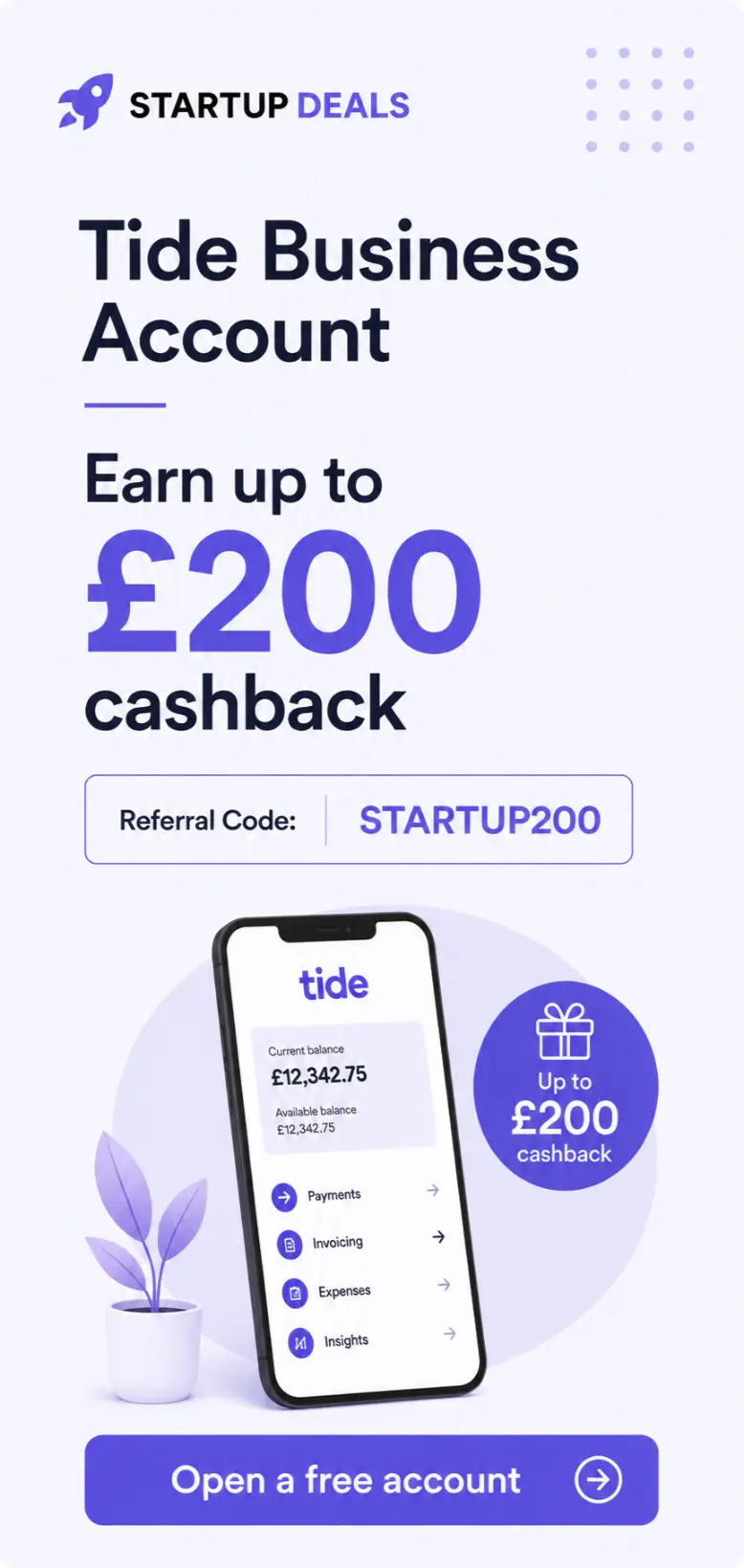
Earn Up to £200 Cashback With Tide for Freelancers
For freelancers looking to open a dedicated business account, Tide currently offers one of the most attractive incentives available to new customers. Eligible applicants can earn up to £200 cashback when opening a new Tide account and meeting the qualifying requirements.
This promotion is particularly valuable for freelancers who are setting up a new business account, separating their personal and business finances, or moving from another banking provider. Since many freelancers already spend money on software subscriptions, business expenses, equipment, advertising, travel, and client-related costs, meeting the spending requirements can often fit naturally into normal business activity.
To qualify for the offer, freelancers should use the referral code STARTUP200 during the account registration process.
The promotion consists of two parts.
The first reward allows eligible customers to receive £75 cashback. To qualify, you must open a qualifying Tide account, use the code STARTUP200 during registration, and spend at least £100 using your Tide card within 30 days of opening the account.
For many freelancers, this spending requirement can be achieved through ordinary business purchases such as software subscriptions, office supplies, marketing costs, coworking memberships, travel expenses, cloud hosting, or professional services.
The second reward offers an additional £125 cashback through Tide’s Instant Saver promotion.
To qualify, you must deposit at least £5,000 into your Tide Instant Saver Account within 7 days of opening the account. The balance must then remain in the account for at least one month in accordance with the offer terms.
Freelancers who maintain larger cash reserves, tax savings, emergency funds, or retained business profits may find this additional cashback particularly attractive.
Combined, these rewards provide the opportunity to earn up to £200 cashback.
If you’re planning to open a business account anyway, taking advantage of the promotion can provide an immediate financial benefit while gaining access to Tide’s invoicing tools, expense management features, and banking services.
? Open your Tide account here: https://startupdeals.co.uk/recommends/tide-business-current-account
Offer Summary
- Use referral code: STARTUP200
- Open an eligible Tide account
- Spend £100 on your Tide card within 30 days
- Receive £75 cashback (subject to qualification)
- Deposit £5,000 into a Tide Instant Saver Account within 7 days
- Maintain the balance for one month
- Receive an additional £125 cashback (subject to qualification)
- Total potential reward: £200 cashback
This offer is subject to eligibility requirements and may change at any time. Always review the latest promotion details before applying.
General FAQs About Tide Business Account
Is Tide good for freelancers?
Many freelancers choose Tide because it combines business banking, invoicing, expense tracking, and accounting integrations within a single platform.
Can sole traders open a Tide account?
Yes. Sole traders represent a significant portion of Tide’s customer base and can typically apply online through the standard application process.
What are the main Tide freelancer benefits?
Key Tide freelancer benefits include separating business finances, creating invoices, tracking expenses, and managing finances through a mobile app.
What Tide freelancer features are most useful?
Popular Tide freelancer features include invoicing tools, spending categorisation, accounting integrations, transaction notifications, and business expense management.
Does Tide offer a business debit card?
Yes. Eligible account holders receive a Tide business debit card that can be used for business purchases and expense tracking.
Can freelancers send invoices through Tide?
Yes. One of the most popular Tide freelancer features is the ability to create and send professional invoices directly through the platform.
Is Tide suitable for new freelancers?
Yes. Many newly self-employed professionals choose a Tide freelancer account because the onboarding process is straightforward and fully digital.
Does Tide integrate with accounting software?
Yes. Tide supports integrations with several accounting platforms that help simplify bookkeeping and financial reporting.
Is Tide regulated in the UK?
Tide is FCA regulated and operates within the UK financial services framework and works with regulated banking partners to provide business banking services.
Is Tide good for startups as well as freelancers?
Many entrepreneurs use Tide business banking for startups because of its business-focused tools, scalability, and digital-first approach.
Can a freelancer later upgrade to a limited company account?
Yes. Many users begin with a freelance or sole trader setup before expanding into a limited company structure as their business grows.
FAQs About the Tide £200 Cashback Offer
What referral code should freelancers use?
Eligible applicants should use the referral code STARTUP200 during registration to qualify for the promotional offer.
How much cashback can I receive?
Eligible customers may receive up to £200 cashback when both promotional requirements are successfully completed.
How do I qualify for the £75 reward?
You must use the STARTUP200 code, open an eligible account, and spend £100 on your Tide card within 30 days.
What counts towards the £100 spending requirement?
Normal business purchases made using your Tide card may qualify, subject to the offer terms and conditions.
How do I qualify for the additional £125 cashback?
You must deposit at least £5,000 into a Tide Instant Saver Account within 7 days of opening and maintain the balance for one month.
Can freelancers qualify for both rewards?
Yes. Freelancers who satisfy both sets of requirements may receive the full £200 cashback offer.
Is the offer available to existing customers?
Promotions are generally aimed at new customers, although applicants should review the latest eligibility criteria before applying.
Does the £5,000 need to be deposited all at once?
The offer terms should be reviewed directly, but qualifying balances generally need to meet the requirements outlined in the promotion.
When will cashback be paid?
Payment timing may vary depending on verification processes and promotional conditions.
Can sole traders claim the offer?
Eligible sole traders may qualify provided they meet all applicable registration and promotional requirements.
Can limited companies claim the offer?
Eligible limited companies may also qualify if they satisfy the terms and conditions.
Is the STARTUP200 promotion worth it for freelancers?
For freelancers planning to open a business account anyway, the cashback can provide a useful additional benefit alongside Tide’s banking and business management features.
Recap
Choosing the right business account can make a significant difference to how efficiently you manage your freelance business. Throughout this guide, we’ve explored the key features, benefits, costs, security protections, and promotional opportunities available through Tide.
For freelancers, one of the biggest advantages is simplicity. The platform combines business banking, invoicing, expense tracking, and accounting integrations within a single ecosystem. Rather than juggling multiple tools and spreadsheets, users can manage much of their financial administration from one place.
We also looked at how Tide supports businesses beyond the freelance stage. The same functionality that makes the platform attractive for self-employed professionals has helped make it a popular choice for entrepreneurs seeking Tide business banking for startups. As a result, freelancers who expect to grow their businesses may find that Tide can continue supporting their needs over the long term.
The current cashback promotion further strengthens the overall value proposition. Eligible freelancers who use the STARTUP200 referral code and satisfy the qualifying conditions may be able to earn up to £200 cashback while setting up a dedicated business banking solution.
If you’re searching for a modern business account that helps streamline administration, improve financial visibility, and support future growth, Tide is certainly worth considering. The combination of banking functionality, business tools, and startup-friendly features continues to make it one of the most popular digital business banking platforms in the UK.
? Open your Tide account here: https://startupdeals.co.uk/recommends/tide-business-current-account
Conclusion
For many self-employed professionals, managing finances efficiently is just as important as winning new clients. A business account should help reduce administration, simplify bookkeeping, improve cash flow visibility, and create a more professional experience when dealing with customers.
Tide for freelancers has become a popular choice because it addresses these needs through a combination of digital banking services and practical business management tools. From invoicing and expense tracking to accounting integrations and real-time transaction monitoring, the platform is designed around the realities of running a modern freelance business.
Freelancers who are currently using personal accounts may find substantial benefits in switching to a dedicated business banking solution. Separating personal and business finances can simplify tax preparation, improve record keeping, and provide greater clarity over business performance. These advantages become increasingly valuable as a freelance business grows.
The platform’s accessibility is another key strength. Whether you’re a newly self-employed sole trader, an experienced contractor, or a freelancer considering future expansion, Tide offers a flexible solution capable of supporting multiple stages of business development. This is one reason why many entrepreneurs researching a Tide startup account ultimately choose the platform.
The available cashback promotion adds further appeal. Eligible customers who use the STARTUP200 referral code and satisfy the qualifying criteria may earn up to £200 cashback while opening their account. For freelancers planning to establish a business account anyway, this can provide a useful additional incentive.
Ultimately, Tide for freelancers offers a strong combination of convenience, functionality, scalability, and value. While every freelancer’s needs will differ, the platform remains one of the most compelling business banking options available to UK self-employed professionals in 2026.
If you’re ready to open an account and take advantage of the current offer, you can get started here:
? https://startupdeals.co.uk/recommends/tide-business-current-account
Offer availability, eligibility requirements, cashback terms, and account features are subject to change. Always review the latest Tide terms and conditions before applying.
Latest Posts:
- Zempler Bank Review 2026: Is It Good Value for UK Startups?
 Introduction Zempler Bank offers a genuine UK business bank account from £0 per month, with app and online banking, Post Office cash deposits and built-in tools for invoicing, receipts and… Read more: Zempler Bank Review 2026: Is It Good Value for UK Startups?
 - Hoxton Mix vs Virtually There: Which Virtual Office Service Is Better?
 Introduction If you’re comparing Hoxton Mix vs Virtually There, you’re likely searching for a virtual office provider that offers the right balance of professionalism, affordability, and flexibility. Whether you’re launching… Read more: Hoxton Mix vs Virtually There: Which Virtual Office Service Is Better?
 - Hoxton Mix vs Icon Offices: Which Virtual Office Is Better?
 Introduction Choosing a virtual office provider can have a significant impact on how your business is perceived, how you manage your mail, and even how effectively you maintain privacy as… Read more: Hoxton Mix vs Icon Offices: Which Virtual Office Is Better?
 - 7 Powerful Benefits of Using a Hoxton Mix Virtual Office Address
 Introduction For startups, freelancers, sole traders and growing SMEs, establishing a professional business presence can be challenging. Renting physical office space in London is often expensive, particularly during the early… Read more: 7 Powerful Benefits of Using a Hoxton Mix Virtual Office Address
 - Hoxton Mix Review: Features, Pricing, Pros and Cons Explained
 Introduction If you’re searching for an honest and detailed hoxton mix review, you’re likely comparing virtual office providers and trying to decide whether Hoxton Mix offers good value for your… Read more: Hoxton Mix Review: Features, Pricing, Pros and Cons Explained
 - Hoxton Mix Virtual Office Discount: Save 10% on Your First 12 Months
 Introduction If you’re looking for a professional London business address without the cost of renting physical office space, a Hoxton Mix Virtual Office discount could help you reduce your startup… Read more: Hoxton Mix Virtual Office Discount: Save 10% on Your First 12 Months
 - Tide Referral Code 2026: Powerful Guide to Claim £200 Cashback with STARTUP200
 Introduction If you’re looking for a Tide referral code in 2026, you’re probably searching for the best possible deal before opening a business account. Whether you’re a sole trader, freelancer,… Read more: Tide Referral Code 2026: Powerful Guide to Claim £200 Cashback with STARTUP200
 - Tide vs High Street Banks: Powerful 2026 Review
 Introduction Choosing the right business banking solution is one of the most important decisions a UK business owner can make. Whether you’re a sole trader, freelancer, contractor, startup founder, or… Read more: Tide vs High Street Banks: Powerful 2026 Review
 - Tide Business Account for Tradespeople | Powerful Guide 2026
 Introduction Running a trade business involves much more than completing jobs and keeping customers happy. Whether you’re a plumber, electrician, builder, carpenter, roofer, landscaper, painter, heating engineer, or general contractor,… Read more: Tide Business Account for Tradespeople | Powerful Guide 2026