Best Business Bank Accounts for Startups in 2026:
Starting a new business in the UK? One of the most important decisions you’ll make is choosing the best business bank accounts for startups to ensure smooth financial management and set your startup up for success
At StartupDeals.co.uk, we’ve done the hard work of researching the best business banking solutions for startups. Read on for comprehensive insights, comparisons, and a deep dive into each account, ensuring you can choose the right one for your startup’s financial needs.
Here at StartupDeals.co.uk, we’ve researched and reviewed the best business bank accounts available, helping you navigate your options with ease. Read on for detailed reviews, comparisons, and all the key information you need to make the best choice for your startup.
Top Business Bank Accounts for Startups:
Tide
- Free Business Current Account
- 3 months free on any paid plan
- Earn up to 4% AER (Variable) on savings
- Apply in minutes
- *Offer T&C's apply (hover to see more)
Monzo
- Free Business Current Account
- Free UK Transfers
- Accounting Integrations
- Real-Time Spending Notifications
- *Offer T&C's apply (hover to see more)
Mettle
- Free business account with no monthly fees
- Built-in invoicing tools to get paid faster
- Automatic expense categorisation
- Set aside money for tax with Pots
- *Offer T&C's apply (hover to see more)
Anna Money
- Free Business Current Account
- 24/7 In-App Support
- Tax & VAT Tools
- Multi-User Access
- *Offer T&C's apply
How to Choose the Best Business Bank Account for Your Startup:
Choosing the best business bank accounts for startups is crucial, whether you’re just launching or looking to expand your business. With the best business bank accounts for startups, you’ll be able to manage expenses, track cash flow, and access the right financial tools. Here’s how it can benefit your business:
Professionalism
Having a business bank account for your startup enhances your credibility, making it easier to manage taxes and set your startup-friendly business bank account up for long-term success.
Financial Clarity
By separating personal and business finances, you gain better control over cash flow, taxes, and expenses. This makes managing your business finances much easier, especially when you need to prepare for tax season.
Access to Business Loans & Credit:
A startup-friendly business bank account can help establish your company’s credit history. This makes it easier to access business loans, lines of credit, or business credit cards as your startup grows.
Best Business Bank Accounts for Startups in the UK:
We’ve carefully researched and compiled the best business bank accounts for startups, ensuring there’s a perfect fit for every type of business. Whether you’re just starting your journey or already scaling your small business, there’s a startup-friendly business bank account designed to meet your needs.
Tide Business Bank Account

Best for: Simple, flexible business banking with no monthly fees.
Monthly Fee: £0
Bank Transfers: Free (domestic transfers)
Card Purchases: Free (business debit card)
Overdraft: Available (subject to eligibility)
FSCS Protection: Yes
Accessibility: Easy-to-use mobile app with automated expense categorisation and invoicing tools
Extras: Multi-user access, real-time financial insights
Highlights: Unlimited transactions, instant payments, and easy-to-use dashboard
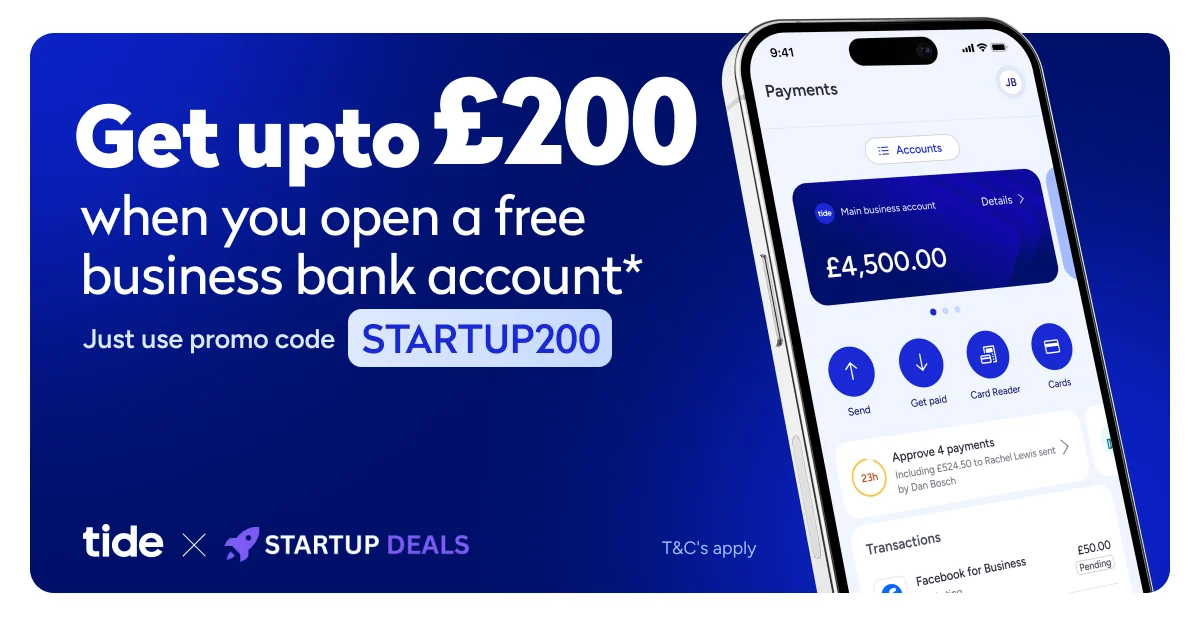
Offer: Get upto £200 cashback when you open a Tide Business Bank Account (T&C’s apply)
Offer T&C’s: Use the code STARTUP200 when you register your business and open your Tide account. Spend £100 on your Tide card within 30 days to unlock your £75 cashback reward. In addition, if you deposit at least £5,000 into your Tide Instant Saver Account within 7 days of opening (and keep it there for one month), you’ll qualify for the additional £125 Tide Instant Saver offer.)
Key Benefits:
✔️ Automated expense categorisation and invoicing tools
✔️ Multi-user access for team collaboration
✔️ Real-time insights directly on your mobile device
Ideal for: Startups looking for flexibility and no monthly fees.
Why Choose Tide?
Tide offers a cost-effective business banking solution with no monthly fees. Its mobile app integrates seamlessly with your business operations, providing you with real-time financial insights and tools for easy bookkeeping and invoicing. Perfect for startups, Tide’s fee-free business account makes managing finances simpler and cheaper.
Sign Up for Tide Today and earn upto £200 cashback*, plus, access all the powerful features of Tide Business Banking.
Read our full Tide Business Bank Account review >> here for more details!
Anna Money Business Bank Account

Best for: Simple, straightforward business banking with integrated tax management.
Monthly Fee: £0
Bank Transfers: 20p (10 free per month)
Card Purchases: £0
Overdraft: Not available
FSCS Protection: No
Accessibility: User-friendly mobile app with built-in VAT management and expense tracking
Extras: Tax tools that automatically calculate and store VAT
Highlights: Instant payment notifications, card payments, and easy-to-use dashboard
Offer: Get 1% cashback on card purchases (terms apply)
Key Benefits:
✔️ VAT and tax tools for automatic calculations and filing
✔️ Instant payment notifications to keep your cash flow on track
✔️ Integration with accounting software for seamless financial management
Ideal for: Freelancers and small startups that need tax management integration with banking.
Why Choose Anna Money?
Anna Money simplifies the financial operations of startups by offering an easy-to-use mobile app that integrates accounting tools like tax and VAT management. It’s the ideal business bank account for startups seeking a straightforward solution.
Sign Up for Anna Money Today and start enjoying 1% cashback on your card purchases.
Read our full Anna Money review >> here for more details!
Monzo Business Bank Account

Monthly Fee: £0 (for the Basic Plan)
Bank Transfers: Free (UK transfers)
Card Purchases: Free (business debit card)
Overdraft: Not available
FSCS Protection: Yes
Accessibility: User-friendly mobile app with built-in expense categorisation and budgeting tools
Extras: Multi-currency support for international transactions, instant notifications for all spending
Highlights: Real-time transaction updates, integration with accounting tools, and easy-to-use dashboard
Offer: £50 cashback when opening a business account* (T&C’s apply)
Offer T&C’s: Get £50 cashback when you signup to Monzo using our link, you must spend on your card within 30 days (excluding virtual cards ATM and Money transfers).
Key Benefits:
✔️ Instant notifications for all transactions, keeping you on top of your finances in real-time
✔️ Seamless integration with accounting software like Xero and QuickBooks
✔️ Multi-currency support, ideal for international transactions
Ideal for: Tech-driven startups that want easy access to real-time financial insights.
Why Monzo is Great for Startups: Monzo offers a startup-friendly business bank account that allows you to track your expenses and cash flow effortlessly, making it an ideal choice for business accounts for startups. Plus, its free business account allows startups to minimise costs while getting access to all the essential banking features.
Sign Up for Monzo Business Account Today and enjoy £50 cashback when opening an account (terms and conditions apply).
Read our full review >> here for more details!
Mettle Business Bank Account

Best for: Early-stage startups and founders looking for a simple, no-cost business account to manage day-to-day finances while scaling.
Monthly Fee: £0
Bank Transfers: Free (domestic transfers)
Card Purchases: Free (business debit card)
Overdraft: Not available
FSCS Protection: Yes
Accessibility: Mobile-first app with real-time transaction tracking and automatic expense categorisation
Extras: Integration with accounting software, financial insights
Highlights: Free UK transfers, real-time transaction updates, and customisation banking features
Offer: Earn £50 cashback when you open a Mettle account. (T&C’s apply)
Offer T&C’s: Once you have opened an account you have 30 days to make a card payment and enter the code ‘QPBB6‘ in the Mettle app.
Startup Benefits: No monthly fees — ideal for keeping early-stage costs low Automated expense tracking to simplify bookkeeping from day one Seamless accounting integrations to support scaling operations
Ideal for: Mettle is well suited to new startups, side projects turning into businesses, and founders who want a straightforward banking setup without ongoing fees. It’s particularly useful if you’re not dealing with complex international payments yet and want something quick to set up and easy to manage.
Why Choose Mettle for Startup? Mettle provides a clean, no-frills banking experience backed by NatWest, making it a solid choice for startups that want reliability without the overhead. With built-in invoicing and accounting integrations, it helps founders stay organised and focused on growth rather than admin.
Sign Up for Mettle Business Account Today and enjoy £50 cashback when opening an account (terms and conditions apply).
Revolut Business Bank Account
Best for: Startups that need international payment capabilities, multi-currency accounts, and advanced financial tools from day one.
Monthly Fee: £10 (Business Basic Plan)
Bank Transfers: Free (UK transfers)
Card Purchases: Free (business debit card)
Overdraft: Available (subject to eligibility)
FSCS Protection: Yes
Platform: App and web-based platform with real-time insights and spend controls
Extras: Multi-currency support, global payments, automated accounting integrations
Highlights: International payments with low fees, instant transfers, and comprehensive financial reports
Offer: n/a
Key Benefits for Startups:
✔️ Built for scaling businesses with international customers or suppliers
✔️ Multi-currency accounts reduce FX costs and friction
✔️ Advanced tools for managing team spending and financial visibility
Who is it best for: Revolut is ideal for startups operating internationally, SaaS companies, eCommerce brands, and fast-growing teams that need flexible, digital-first banking with global reach.
Why Choose Revolut for a Startup?
Revolut stands out as a feature-rich platform designed for modern, globally-minded startups. While it isn’t a free account, it offers significantly more flexibility than traditional banks, particularly when it comes to international payments, multi-currency management, and team expense control — all essential for scaling businesses.
Wise Business Bank Account

Best for: International businesses and freelancers who need a simple, low-cost, multi-currency business banking solution.
Monthly Fee: £0
Bank Transfers: Free (domestic transfers)
Card Purchases: Free (business debit card)
Overdraft: Not available
FSCS Protection: Yes (up to £120,000, as it is a regulated e-money institution)
Accessibility: Easy-to-use mobile app and web platform with multi-currency accounts, international payments, and expense tracking tools
Extras: Low fees for international transfers, integrated with accounting software like Xero
Highlights: Hold and convert 50+ currencies, low-cost international payments, and transparent exchange rates
Offer: n/a
Key Benefits:
✔️ Multi-currency support: allowing you to hold over 50 currencies at real exchange rates
✔️ Low-cost international transfers with transparent fees
✔️ Real-time tracking: See the exact amount of each transfer before it’s sent and track payments with ease
✔️ Easy integration with accounting software like Xero
Ideal for: International startups that need a low-cost, multi-currency banking solution.
Why Choose Wise?
For businesses dealing with international clients or freelancers operating globally, Wise offers one of the best startup-friendly business bank accounts. With low fees, transparent exchange rates, and multi-currency support, Wise is the ultimate banking solution for startups focused on global expansion.
Read our full review >> here for more details!
Airwallex Business Account

Best for: Startups that are growing სწრაფly or operating internationally and need a flexible platform for managing payments, currencies, and financial workflows.
Monthly Fee: £0 (core account)<br>Fees apply depending on usage (e.g. FX, transfers)
Bank Transfers: Free local transfers (fees may apply for international transfers)
Card Purchases: Free (virtual and physical cards available)
Overdraft: Not available
FSCS Protection: Not covered (funds are safeguarded)
Accessibility: Web and mobile platform with real-time financial insights
Extras: Multi-currency accounts, global payment infrastructure, API access, and accounting integrations
Highlights: Manage multiple currencies, automate payments, and streamline global transactions
Offer: n/a
Key Benefits:
✔ Built for startups scaling across borders
✔ Multi-currency accounts help reduce FX costs and complexity
✔ Advanced tools for automating payments and financial operations
Ideal for: Startups, SaaS companies, eCommerce brands, and tech businesses that need a modern financial platform to support growth and international expansion.
Why Choose AirWallex?
Airwallex is designed for startups that are moving beyond basic banking. It provides the infrastructure to manage international payments, handle multiple currencies, and automate financial processes — all in one place. This makes it especially valuable for founders looking to scale efficiently without being limited by traditional banking systems.
What are Business Bank Accounts?
A business bank account is a specialised financial account designed to meet the unique needs of startups, freelancers, sole traders, and small companies. Whether you need a startup-friendly business bank account or a more advanced solution, these accounts help streamline financial management. These accounts help separate business transactions from personal finances, making it easier for entrepreneurs to manage cash flow, track expenses, handle taxes, and keep financial records organised.
Business accounts often come with essential features such as debit cards, online banking, the ability to accept payments from clients, and sometimes cheque writing. More than just a tool for managing finances, these accounts help businesses build credibility and professionalism—an important factor when dealing with customers, suppliers, and potential investors.
What Banks Support Startups:
There are two primary types of business bank accounts for startups: accounts offered by traditional banks and challenger banks (digital-only solutions).
Traditional Banks: These institutions provide a wider range of services, including in-person support, a variety of financial products, and extensive experience in business banking. They are ideal for businesses that require a mix of physical banking services and advanced financial products.
Challenger Banks: Digital-only banks that offer more flexible and startup-friendly business bank accounts. These accounts are tailored for businesses that need quick access to essential financial tools and lower fees. They’re ideal for businesses that are comfortable with online-only banking and need quick, easy access to essential financial services.
What Are the Different Types of Business Bank Accounts?
Here are the most common types of business bank accounts available:
Current Accounts: These are the most common type, used for everyday transactions like paying bills, processing payments, and managing expenses.
Savings Accounts: Business savings accounts allow businesses to store surplus funds and earn interest over time.
Merchant Accounts: These accounts help businesses process card payments, essential for e-commerce businesses or physical stores.
Foreign Currency Accounts: For businesses that deal with international transactions, these accounts help avoid currency exchange fees.
Fixed Deposit Accounts: These accounts are designed to lock funds for a specified period to earn a better interest rate.
Client Accounts: Used by businesses like solicitors or estate agents to hold client funds in trust.
How Do Business Bank Accounts Work?
A business bank account is essential for effectively managing your company’s finances. By keeping business funds separate from personal ones, these accounts help you maintain better control over cash flow, budgeting, taxes, and financial reporting.
These accounts are primarily used for the following:
-
✔️ Receiving payments from customers or clients, including payments via card or bank transfer
-
✔️ Paying business expenses, such as payroll, supplier payments, and operational costs
-
✔️ Tracking transactions, which aids in budgeting, cash flow management, and tax preparation
In addition to basic banking services, business bank accounts often offer features such as debit card access, cheque writing, and online banking. Many accounts also include additional services like merchant services to process payments, as well as business loans and credit facilities to support your business’s growth and financial needs.
Key Features of Business Bank Accounts:
-
Transaction Management: Easily track and categorise expenses for better financial planning.
-
Integrated Payment Solutions: Simplify payment processing for both you and your clients.
-
Access to Credit: Secure loans or credit lines to fund business expansion.
By using a dedicated business bank account, you not only simplify your financial operations but also increase your credibility with customers, suppliers, and potential investors.
What’s the Difference Between Personal and Business Bank Accounts?
While both personal and business bank accounts serve as a way to manage finances, there are several key differences that make a business bank account for startups essential for managing company finances.
1. Purpose:
Personal Accounts: These are designed for managing individual finances, such as paying personal bills, receiving salary payments, and handling everyday expenses.
Business Accounts: Specifically designed to manage business transactions and startup financial management. A business bank account for startups helps you handle payments from clients, manage business expenses, and ensure that all business-related finances are kept separate from personal funds.
2. Features:
Personal Accounts: Limited to personal financial needs, such as cash withdrawals, direct debits, and budgeting tools.
Business Accounts: Business bank accounts come with additional features like higher transaction limits, the ability to accept payments from clients, credit facilities, and merchant services to process card payments. These features are tailored to support the specific needs of startups and small businesses.
3. Regulations:
Personal Accounts: Governed by individual financial rules and personal taxation laws.
Business Accounts: Subject to business banking regulations, including different taxation rules and business laws. For example, you may need to track and report VAT, make regular financial filings, and comply with business tax obligations. Find more details on business banking requirements for startups in the UK from the UK Government’s official website.
4. Tools and Services:
Personal Accounts: Do not provide the tools needed to manage business finances such as business loans, expense tracking, or merchant services.
Business Accounts: Offer specialised tools like integrated accounting software, expense management, access to business loans or credit, and the ability to process payments through merchant accounts.
In summary, a business bank account for your startup is essential for managing your company’s finances in a way that supports growth, keeps operations running smoothly, and ensures compliance with relevant financial regulations.
Do I Need a Business Bank Account for my startup?
While having a business bank account for startups is not a legal requirement for every type of business, it is highly recommended and essential for various reasons, especially as your business grows.
1. For Limited Companies:
If your business is registered as a limited company, you must have a separate business account. This is required by law to ensure that your company’s financial transactions are clearly separated from your personal finances. A business account for your startup also helps you establish credibility and professionalism in the eyes of clients, suppliers, and investors.
2. Professional Image:
A business bank account enhances your startup’s professional image by ensuring that your business finances are kept separate from your personal ones. This creates trust with clients, vendors, and investors, positioning your startup as organised and legitimate.
3. Tax Filing and Bookkeeping:
Separating your business and personal finances makes tax filing and bookkeeping much easier. A dedicated business bank account for startups simplifies tax reporting, helps you keep track of business expenses, and ensures you stay compliant with tax regulations, reducing the risk of complications during tax season.
4. For Sole Traders and Freelancers:
If you’re a sole trader or freelancer and don’t have a registered business structure, a business account is not mandatory. However, having a separate business account is still a smart choice to keep your finances organised, streamline your expense tracking, and improve financial management for freelancers and self-employed entrepreneurs.
Benefits of Using a Business Bank Account for Your Startup:
As a startup, using a business bank account offers several crucial advantages that can help streamline your financial operations and set your business up for long-term success.
1. Separation of Finances
A business bank account for startups ensures that your business and personal finances are kept separate. This makes it easier to track your startup’s expenses, monitor profits, and maintain clear financial records, especially when preparing for taxes or audits.
2. Professional Image
Having a dedicated business bank account enhances your startup’s professional image. It allows you to present your business as legitimate and organised to clients, vendors, and investors, helping you build trust and credibility from the outset.
3. Simplified Invoicing and Payments
A business bank account simplifies the process of accepting payments from clients and issuing invoices. It helps you manage cash flow efficiently, ensuring your startup’s finances are handled smoothly and securely. Many startup-friendly business bank accounts also offer integrated payment solutions, which can further streamline these processes.
4. Builds Business Credit
Opening a business bank account for a startup helps establish a business credit history. This can be invaluable when you need to apply for business loans, credit cards, or other financial products as your business grows, giving you access to additional funding options.
5. Improved Financial Management
Many business accounts come with built-in tools to help with expense tracking, budgeting, and financial planning. These tools provide real-time insights into your startup’s financial health, making it easier to make informed decisions.
How to Choose the Best Business Bank Account for Your Startup:
Choosing the right business bank account for your startup is crucial, whether you’re just launching or looking to expand your business. With the best business bank accounts for startups, you’ll be able to manage your expenses and track your cash flow efficiently. Here’s a breakdown of the key points to guide your decision:
1. Fees and Charges
Startups are often on a tight budget, so it’s essential to consider the fees associated with each business bank account. Look for accounts that offer no monthly fees or transaction fee-free options. Be sure to review fees for services like international transfers, overdrafts, and additional features that may be charged separately.
2. Interest Rates
Some business bank accounts for startups offer interest on deposits, which can help your business earn money on idle funds. Make sure you understand whether your chosen account offers this benefit, and check the interest rates over time, especially if you plan to keep substantial cash in your account.
3. Overdraft Facilities
If your startup needs access to additional cash flow, check whether the bank offers overdraft facilities. Ensure you understand the interest rates and terms associated with overdrafts, as they can help manage unforeseen expenses or cash flow gaps in your business.
4. Digital Banking Features
As a startup, you may prefer a digital-only business bank account with features like mobile apps, online banking, and easy access to financial tools. If your business is based online or operates remotely, digital banking can save you time and help you manage your finances on the go. Make sure the bank’s digital solutions match your business’s needs.
5. Integration with Accounting Software
Look for business accounts that integrate with popular accounting software like Xero, QuickBooks, or FreshBooks. Integration with these tools will streamline your financial management, making it easier to track expenses, income, and taxes—especially important for a startup that needs to stay organised from day one.
6. Customer Service
Good customer service is essential, particularly when managing the finances of a startup. Ensure that the bank offers 24/7 support or has strong service hours that suit your needs. Read reviews and check the quality of service, as having access to reliable support can make or break your experience.
Pros and Cons of a Business Bank Account for Startups:
Having a business bank account for your startup offers numerous benefits, but there are also a few considerations to keep in mind. Here’s a breakdown of the pros and cons to help you make an informed decision.
Pro’s:
✔️ Separation of Personal and Business Finances: By opening a business bank account for your startup, you can easily keep your personal and business finances separate. This makes it simpler to track business expenses, monitor cash flow, and maintain accurate records, which is essential for tax filing and financial management.
✔️ Builds Business Credit:
A dedicated business bank account helps establish a business credit history. This is crucial for future funding or applying for business loans and credit cards. Having good business credit can provide your startup with greater access to financial opportunities as you grow.
✔️ Tax Benefits: Separating your personal and business transactions makes tax filing much easier. A business bank account for startups helps you organise receipts, track expenses, and calculate profits, simplifying your tax reporting and reducing the risk of errors or complications.
✔️ Professional Image: A business account enhances your startup’s professional image by showing clients, suppliers, and investors that you’re organised and serious about your business. It also instils confidence in your customers, knowing they’re dealing with a legitimate, professional entity.
Cons:
❌ Higher Fees: While some business bank accounts come with no monthly fees, many others may charge higher fees compared to personal accounts. It’s important to weigh these costs against the features and benefits the account provides, such as invoicing tools, payment processing, and merchant services.
❌ More Administration:
Managing a business bank account means keeping track of more transactions, which can lead to additional bookkeeping and financial organisation. This may take more time and effort, especially for startups with limited resources. However, choosing an account with integrated accounting tools can help streamline the process.
❌ Minimum Deposit Requirements: Some business accounts for startups may require an initial deposit or a minimum monthly balance. While this is common, it could be a barrier for new businesses with limited cash flow. Be sure to check these requirements before opening an account to ensure it fits within your budget.
Steps to Open a Business Bank Account for Your Startup:
Opening a business bank account for your startup is a straightforward process, but it’s important to be prepared. Here’s a step-by-step guide to help you through the process:
1. Choose a Bank
Start by researching and comparing different banks that offer business bank accounts. Consider factors such as fees, features, customer service, and any special offers for startups. Look for accounts that cater specifically to small businesses or startups, and ensure the features align with your business needs, such as digital banking tools, payment processing, and accounting software integrations.
2. Prepare Required Documents
You’ll need to gather a few essential documents to open a business bank account. These may include:
Proof of identity (e.g., passport, driving license)
Proof of business address (e.g., utility bill, lease agreement)
Company registration information (e.g., certificate of incorporation, partnership agreement)
Business activity details (some banks may ask about the nature of your business)
Additional information may be required depending on the bank or your business structure. For example, sole traders may need to provide their National Insurance number, and limited companies may need to supply director details or articles of association.
3. Apply
Once you’ve chosen a bank and prepared the necessary documents, you can apply for your business bank account. Many banks now offer online applications that can be completed through their websites or mobile apps. Alternatively, you can visit a branch to complete the application in person.
4.Verification Process
After you’ve submitted your application, the bank will review your documents and may require additional verification. This could include confirming your business address, financial history, or verifying the ownership structure of your company. Some banks may also request further details about your business activities for regulatory compliance (e.g., anti-money laundering checks).
5. Fund Your Account
Once your business account is approved, you’ll need to deposit initial funds as required by the bank. Some accounts have a minimum deposit or balance requirement, so be sure to check this before proceeding. After funding your account, you can start using it for all your business transactions, such as receiving payments, paying bills, and managing cash flow.
Comparison of Business Accounts for Startups:
 |
 |
 |
 |
 |
|
|---|---|---|---|---|---|
| Opening Fee | £0 | £0 | £0 | £0 | £0 |
| Monthly Cost | £0 Free £12.50–£69.99 Paid |
£0 Free £14.90 Paid |
£0 Free £5 Pro £15 Premium |
£0 (Free only) | £0 Free |
| Card Transactions | Free | Free (limit) | Free UK | Free UK | Free UK |
| Transfers | Free UK | Free (limit) | Free UK | Free UK | Free major currencies |
| ATM Withdrawals | £1 | Free to £500 | Free to £250 | ✕ | Free |
| Tap to Pay | ✓ | ✓ | ✓ | ✓ | ✓ |
| Payment Links | ✓ | ✓ | ✓ | ✓ | ✓ |
| Accounting Integrations | ✓ | ✓ | ✓ | ✓ | ✓ |
| FSCS Protection | ✓ | ✕ | ✓ | ✓ | ✕ |
| Sign-Up Offer |
Up to £200 cashback* T&Cs apply Use the code STARTUP200 when you register your business and open your Tide account. Spend £100 on your Tide card within 30 days to unlock your £75 cashback reward. In addition, if you deposit at least £5,000 into your Tide Instant Saver Account within 7 days of opening (and keep it there for one month), you’ll qualify for the additional £125 Tide Instant Saver offer. Check full Tide terms for eligibility and qualifying actions. |
1% cashback* T&Cs apply Cashback subject to limits and usage requirements. |
£50 cashback* T&Cs apply Eligibility and qualifying activity required. Get £50 cashback when you signup to Monzo using our link, you must spend on your card within 30 days (excluding virtual cards ATM and Money transfers). |
£50 cashback* T&Cs apply Earn £50 cashback when you open a Mettle account. Once you have opened an account you have 30 days to make a card payment and enter the code 'QPBB6' in the Mettle app. Eligibility criteria apply. |
N/A |
| Apply Now | Apply Now | Apply Now | Apply Now | Apply Now |
Alternative Business Banking Options for Startups:
While traditional business bank accounts are a great option for many startups, there are alternative business banking solutions that may suit your needs better, depending on the type and scale of your business. Here are some alternatives worth considering:
1. E-Money Accounts:
E-money accounts are digital-only accounts provided by non-bank financial institutions. These are a popular choice for startups looking for a cost-effective and flexible solution to manage their finances without the high fees often associated with traditional banks. E-money accounts generally offer lower transaction fees, fast online setup, and easy integration with other digital tools.
However, note that these accounts are typically not covered by the Financial Services Compensation Scheme (FSCS), so if the provider goes out of business, your funds may not be protected. This may not be a concern for all startups, but it’s important to be aware of the potential risks.
2. Payment Service Providers (PSPs):
Payment Service Providers (PSPs) like PayPal, Stripe, and Square are excellent alternatives for startups that rely on e-commerce or need a simple way to process payments. These services allow you to accept credit card payments, send invoices, and manage transactions without needing a traditional business bank account. Many startups in the online retail, freelancing, and services sectors benefit from using PSPs to streamline their financial operations.
PSPs often provide additional features like easy integration with online stores, real-time reporting, and multi-currency support for international transactions, making them a great choice for businesses that plan to expand globally.
FAQ's:
Can I open a business account if I’m a sole trader?
Yes, absolutely! Many business bank accounts for startups, such as Tide and Anna Money, are specifically designed for sole traders. These accounts offer easy online applications, low or no monthly fees, and essential tools like expense tracking and invoicing to help you manage your finances efficiently.
What documents do I need to open a business bank account for my startup?
To open a business bank account for startups, you’ll typically need:
-
Proof of identity (e.g., passport or driver’s license)
-
Proof of business address (e.g., utility bill or lease agreement)
-
Company registration details (e.g., certificate of incorporation if you’re a limited company)
-
National Insurance number (for sole traders)
Additional documentation may be required depending on your business structure or bank, so it’s best to check the bank’s requirements before applying.
Are there fees for business accounts for startups?
Some business bank accounts come with monthly fees, while others offer fee-free accounts. It’s important to compare the fees, such as transaction charges, ATM withdrawal fees, and foreign transfer fees, before opening an account. Many startup-friendly accounts, like Tide and Anna Money, offer no monthly fees, which can help reduce your costs as you grow your business.
How long does it take to open a business account for my startup?
The process of opening a business bank account can be quick and easy, with many banks offering online applications. If you apply online, it can take as little as 15-30 minutes to complete your application. However, the approval process may take up to a few days depending on the bank’s verification process. Once your application is approved, you may be able to start using your account immediately.
Are there business accounts specifically for startups?
Yes, there are many business bank accounts for startups designed to meet the unique needs of new businesses. These accounts often come with low fees, easy online access, and startup-friendly features such as expense management tools, tax tools, and invoicing capabilities. Some great options for startups include Tide, Monzo, and Anna Money, which cater specifically to the needs of small businesses and freelancers.
What are the best business bank accounts for startups in the UK?
The best business bank accounts for startups typically offer low fees, simple online setup, and tools that help new businesses manage cash flow. Comparing providers is key to finding the right fit.
Why do startups need startup-friendly business bank accounts?
Startup-friendly business bank accounts are designed with flexibility, fast onboarding, and digital tools in mind, making them ideal for early-stage businesses looking for efficient financial management.
How do I choose between the best business bank accounts for startups?
When comparing the best business bank accounts for startups, consider transaction fees, integrations with accounting software, and the availability of support tailored to new businesses.
What is the process for opening a business bank account for a startup?
Opening a business bank account for a startup usually requires proof of ID, business registration, and a business plan. Many providers now allow the process to be completed online within minutes.
Are online banks offering the best business bank accounts for startups?
Yes, many online providers deliver some of the best business bank accounts for startups, often with lower fees and modern features compared to traditional banks.
What features make a bank account startup-friendly?
Startup-friendly business bank accounts often include free banking periods, invoicing tools, integrations, and no minimum deposit requirements — making them more accessible to founders.
Can I use a personal account instead of the best business bank accounts for startups?
While possible, it’s not recommended. The best business bank accounts for startups keep business and personal finances separate, which is essential for tax and growth.
How do I compare business accounts for startups effectively?
A comparison of business accounts for startups should cover fees, online features, overdraft options, and customer support. This ensures you choose from the best business bank accounts for startups.
Do fintechs provide the best business bank accounts for startups?
Fintechs are often considered providers of the best business bank accounts for startups because they specialise in speed, low costs, and digital-first solutions.
What are the costs of startup-friendly business bank accounts?
Some startup-friendly business bank accounts are free for a set period, while others charge small monthly fees. The best business bank accounts for startups are those that match your budget and stage of growth.
Is opening a business bank account for a startup difficult?
No, opening a business bank account for a startup is usually straightforward. Many banks now offer digital applications to speed up the process.
Which banks provide the top comparison of business accounts for startups?
Independent sites often publish a comparison of business accounts for startups, highlighting the best business bank accounts for startups based on fees, features, and customer reviews.
Do the best business bank accounts for startups include credit options?
Some of the best business bank accounts for startups offer credit or overdrafts, though these may be limited until your business has built a financial track record.
Are there startup-friendly business bank accounts with free banking?
Yes, several providers offer startup-friendly business bank accounts with free banking for 12–18 months to help founders save money in the early stages.
What should I look for when opening a business bank account for a startup?
Look for low fees, digital banking tools, and strong customer support. These features are common in the best business bank accounts for startups.
Do I need a UK-registered business to open a business bank account for a startup?
Yes, most banks require a UK-registered business. However, many providers of the best business bank accounts for startups also accept sole traders and freelancers.
Can I switch providers after opening a business bank account for a startup?
Yes, the Current Account Switch Service makes it easy to move to the best business bank accounts for startups if you find a better option.
Do the best business bank accounts for startups integrate with accounting software?
Yes, many startup-friendly business bank accounts integrate with Xero, QuickBooks, and FreeAgent, simplifying financial management for new businesses.
Which providers offer the fastest opening of a business bank accounts startups?
Challenger banks usually provide the fastest process when opening a business bank account for startups, with approvals sometimes within hours.
Why compare business accounts for startups before choosing?
A comparison of business accounts for startups helps identify the best business bank accounts for startups based on your unique needs, from pricing to features and support.
Do the best business bank accounts for startups help with international payments?
Yes, many of the best business bank accounts for startups include international transfer options. Startup-friendly business bank accounts often provide competitive rates for global transactions.
Are there specialised business banking solutions for startups in tech or e-commerce?
Yes, some providers offer tailored business banking solutions for startups in high-growth industries. These can include integrations with payment gateways, invoicing tools, and digital wallets.
Can I open a business bank account for a startup before I officially register my company?
Some providers allow you to begin opening a business bank account for a startup while your company registration is in progress, making it easier to hit the ground running once you’re incorporated.
How does a comparison of business accounts for startups help save money?
A detailed comparison of business accounts for startups shows differences in fees, free banking periods, and support. This ensures you pick the best business bank accounts for startups without overspending.
Do the best business bank accounts for startups include expense management tools?
Yes, many startup-friendly business bank accounts now include expense tracking, card management, and budgeting features. These business banking solutions for startups help streamline financial admin.
Are the best business bank accounts for startups suitable for early-stage businesses?
Yes, the best business bank accounts for startups are designed specifically for early-stage businesses, offering low fees, simple setup, and flexible features that support growth from day one.
What business banking solutions for startups offer the most flexibility?
Modern business banking solutions for startups often include app-based banking, instant notifications, accounting integrations, and scalable pricing, making them ideal for fast-moving startup teams.
Can startup-friendly business bank accounts support rapid growth?
Yes, startup-friendly business bank accounts are built to scale as your business grows, supporting higher transaction volumes, additional users, and advanced financial tools over time.
Is opening a business bank account for a startup faster with online banks?
Opening a business bank account for a startup is often much faster with online and fintech banks, with some providers offering approval in minutes rather than days.
Do the best business bank accounts for startups offer free banking periods?
Many of the best business bank accounts for startups include introductory free banking periods, helping new businesses reduce costs during their early stages.
Conclusion: Choose the Best Business Bank Account for Your Startup Today
Choosing the best business bank accounts for startups is crucial for managing finances efficiently. Whether you’re looking for a free business account, international payment solutions, or tax management integration, there’s an account out there that fits your needs.
Start comparing the best business banking solutions for startups today and choose the right business bank account for your startup to take the first step towards financial success.
Start Your Business Journey Today with the Best Business Bank Account:
Explore our top business bank account picks and get started today! With no monthly fees, powerful features, and excellent customer support, the right account can streamline your business’s financial management and help you focus on growth.