

Introduction
Managing business finances as a self-employed professional can quickly become complicated. Whether you’re a freelancer, consultant, tradesperson, online seller, contractor, or side-hustle entrepreneur, keeping personal and business transactions separate is often one of the first steps towards running a more organised business. This is where a Tide business account for sole traders can be particularly useful.
Tide has become one of the UK’s most recognised digital business banking providers, offering a fast online application process, invoicing tools, accounting integrations, expense management features, and business finance solutions designed specifically for small businesses. Unlike many traditional banks that require branch visits and lengthy application procedures, Tide allows eligible applicants to open an account entirely online.
If you’re currently researching a Tide sole trader account, comparing digital banking providers, or wondering whether a Tide bank account for sole traders is the right fit for your business, this guide covers everything you need to know. We’ll explore features, fees, eligibility requirements, security, integrations, benefits, drawbacks, and how Tide compares with alternative business banking providers.
For eligible applicants, Tide is currently offering an exclusive cashback promotion that could provide up to £200 in rewards when qualifying conditions are met. If you’d like to check the latest offer details and apply, you can do so here: https://startupdeals.co.uk/recommends/tide-business-current-account
Please note that all offers are subject to eligibility requirements and may change or be withdrawn without notice.
One question many business owners ask is: is Tide good for sole traders? The answer depends on your specific requirements. Some sole traders prioritise low fees and easy administration, while others value accounting integrations, cash management features, or access to business credit products. Throughout this guide, we’ll help you determine whether Tide aligns with your needs.
We’ll also answer common questions such as can a sole trader open a Tide account, how quickly applications are processed, whether deposits are protected, and how Tide’s features compare to traditional business current accounts.
By the end of this guide, you’ll have a clear understanding of whether a Tide sole trader account offers the right combination of convenience, functionality, and value for your business in 2026.
Contents:
- What Is Tide?
- Tide Business Account for Sole Traders
- Who Can Use Tide?
- Key Features
- Benefits for Sole Traders
- Fees and Pricing
- How to Open an Account
- Cash Deposits and Payments
- Accounting Integrations
- Tide vs Competitors
- Earn Up to £200 Cashback
- Security and Regulation
- General FAQs
- Offer FAQs
- Recap
- Conclusion
What Is Tide?
Tide is a UK-based financial technology company focused on providing banking and financial management services for small businesses, startups, freelancers, contractors, and sole traders. Since launching, the company has grown significantly by offering a digital-first alternative to traditional business banking providers.
Unlike many high-street banks, Tide operates primarily through its mobile app and online platform. This allows customers to manage their business finances from anywhere, whether that’s an office, construction site, coffee shop, client location, or home workspace. The platform aims to simplify business banking by combining current account functionality with business management tools.
A major reason many self-employed professionals consider a Tide business account for sole traders is the convenience of opening and managing an account entirely online. The application process is designed to be straightforward, removing much of the paperwork commonly associated with traditional business banking applications.
Tide’s platform extends beyond basic banking functionality. Users can create and send invoices, categorise transactions, manage expenses, issue payment reminders, and connect accounting software. These features help reduce administrative workloads and provide a clearer overview of business finances.
For sole traders, this can be particularly valuable. Many self-employed individuals manage every aspect of their business independently, including bookkeeping, invoicing, tax preparation, and cash flow monitoring. Having these tools integrated into one platform can save considerable time throughout the year.
The Tide sole trader account is suitable for many different types of self-employed professionals. Freelancers, consultants, online sellers, tradespeople, delivery drivers, content creators, and contractors may all find value in the platform’s business-focused features.
Another reason people search for a Tide bank account for sole traders is the speed of setup. Traditional business banks can sometimes require extensive documentation and lengthy review processes. Tide aims to streamline onboarding while still meeting regulatory requirements.
Many prospective customers also ask, is Tide good for sole traders? In many cases, the answer depends on how much value a business owner places on digital convenience, automation, and integrated financial management tools. Tide’s approach is designed specifically for smaller businesses rather than larger corporations with complex banking requirements.
As we explore further throughout this guide, you’ll see that Tide offers more than just a business account. Its ecosystem includes invoicing tools, accounting integrations, expense tracking, business savings options, and access to funding products. This broader approach helps explain why so many self-employed professionals are considering Tide as their primary business banking solution.

Tide Business Account for Sole Traders
The Tide business account for sole traders is specifically designed to help self-employed professionals separate business finances from personal spending while gaining access to tools that support day-to-day financial management.
Many sole traders start their business journey using a personal current account. While this may seem convenient initially, it can become increasingly difficult to track income, expenses, invoices, and tax obligations as business activity grows. A dedicated business account often provides greater visibility and organisation.
A Tide sole trader account offers features aimed at simplifying these challenges. Account holders can receive payments, make transfers, manage spending, create invoices, and track financial activity through the Tide mobile application. This centralised approach makes it easier to monitor business performance throughout the year.
One of the most common questions asked online is can a sole trader open a Tide account. The answer is yes. Eligible UK sole traders can apply for a Tide account and access many of the same features available to limited companies. This allows freelancers, contractors, consultants, and other self-employed individuals to benefit from dedicated business banking tools without needing to incorporate a company.
The Tide bank account for sole traders also supports financial administration through automation features. Transactions can be categorised, receipts can be captured digitally, and accounting software integrations can help reduce manual bookkeeping tasks.
For sole traders who submit annual Self Assessment tax returns, maintaining clear financial records is essential. Using a separate business account can make tax preparation significantly easier by keeping business transactions distinct from personal purchases.
Another factor contributing to Tide’s popularity is flexibility. Businesses can often manage finances entirely from their smartphone, making the platform particularly attractive for mobile workers and service-based professionals.
When considering whether is Tide good for sole traders, it is worth examining how frequently you’ll use features such as invoicing, accounting integrations, cash deposits, and business savings products. Businesses that regularly use these services may gain substantial value from the platform.
The account can also help project a more professional image. Clients often prefer paying into a dedicated business account rather than a personal account, particularly when working with freelancers and contractors.
Ultimately, the Tide business account for sole traders combines business banking functionality with administrative tools designed to help self-employed professionals save time and stay organised. For many growing businesses, this combination can be far more valuable than simply having a place to hold funds.
Who Can Use Tide?
Tide is designed to support a broad range of UK business owners, but it is particularly popular among sole traders, freelancers, contractors, startups, and small businesses looking for a straightforward digital banking solution. One reason for this popularity is that the platform offers a relatively simple application process compared with some traditional business banking providers.
If you’re wondering can a sole trader open a Tide account, the answer is generally yes, provided you meet Tide’s eligibility requirements and complete the necessary identity verification checks. The platform is specifically designed to accommodate self-employed professionals who need a dedicated account for managing business finances. This includes individuals working as consultants, graphic designers, tradespeople, online retailers, delivery drivers, marketing professionals, content creators, and many other forms of self-employment.
A Tide sole trader account can be particularly useful for businesses that operate remotely or rely heavily on digital tools. Because the account is managed primarily through the Tide app and online platform, users can access their financial information wherever they have an internet connection. This flexibility appeals to many modern business owners who do not want to rely on branch-based banking.
The Tide business account for sole traders is also suitable for individuals who are just starting a business. Many new entrepreneurs want a simple way to separate personal and business finances from day one. Establishing this separation early can make bookkeeping easier and reduce confusion when preparing tax returns.
Tide is not limited to sole traders. Limited companies, partnerships, and certain other business structures may also be eligible depending on their circumstances. However, the platform’s ease of use makes it particularly attractive to self-employed individuals who manage their own finances without a dedicated finance team.
When considering whether is Tide good for sole traders, it helps to think about your business model. If you issue invoices regularly, need accounting integrations, want mobile banking functionality, or prefer a digital-first approach, Tide may be a strong option. Businesses that primarily operate online often find the platform especially convenient.
The Tide bank account for sole traders can also support growing businesses. As revenue increases and financial administration becomes more complex, features such as expense management, transaction categorisation, and invoice creation can help maintain organisation and efficiency.
It’s important to note that applicants must satisfy Tide’s onboarding and verification requirements. Like all regulated financial providers, Tide performs checks to comply with anti-money laundering regulations and other legal obligations. These checks help ensure the security and integrity of the platform.
For many self-employed professionals, Tide’s combination of accessibility, business-focused tools, and digital convenience makes it a compelling option. Whether you’re launching a new venture or looking to upgrade your existing banking arrangements, the platform is designed to accommodate a wide range of business needs.
Key Features
One of the biggest reasons business owners consider a Tide business account for sole traders is the extensive range of features available through the platform. Rather than simply providing a place to store business funds, Tide combines banking functionality with practical tools that support everyday business administration.
At the centre of the platform is the business current account itself. Users can send and receive payments, manage balances, and review transaction history directly through the Tide app. The interface is designed to be user-friendly, helping sole traders stay on top of their finances without requiring advanced accounting knowledge.
A standout feature of the Tide sole trader account is integrated invoicing. Users can create professional invoices, send them to clients, and track payment status from within the platform. This can reduce the need for separate invoicing software, particularly for freelancers and service-based businesses.
Expense management is another key benefit. The Tide bank account for sole traders allows users to categorise spending and attach digital copies of receipts to transactions. This feature can be especially valuable when preparing tax returns or reviewing business expenditure throughout the year.
Accounting software integration is also available. Tide connects with several popular accounting platforms, helping automate bookkeeping processes and reduce manual data entry. For sole traders managing their own accounts, these integrations can save significant time and minimise administrative errors.
Cash flow visibility is another important feature. Through the app, users can quickly review incoming payments, outgoing expenses, and overall account activity. Having real-time financial information available on demand helps business owners make more informed decisions.
Business savings products are also available to eligible users. Depending on the products available at the time, account holders may have access to savings options designed to help businesses earn interest on surplus funds. This can be particularly useful for sole traders building tax reserves or maintaining emergency funds.
Another feature frequently highlighted by users is the ability to issue and manage business debit cards. These cards can simplify business spending while maintaining a clear separation between personal and company expenses.
When evaluating whether is Tide good for sole traders, the platform’s ability to combine multiple financial management tools within a single ecosystem is often a major advantage. Instead of juggling separate banking, invoicing, and bookkeeping solutions, many users can manage these activities from one place.
The Tide business account for sole traders also benefits from ongoing platform development. New features and enhancements are regularly introduced, helping businesses adapt to changing financial management requirements. For sole traders seeking a modern, technology-driven banking solution, these features can provide substantial value beyond traditional banking services.
Benefits for Sole Traders
There are many reasons why self-employed professionals choose a Tide business account for sole traders over a traditional personal current account. While every business has different priorities, several advantages consistently stand out among Tide users.
One of the most important benefits is financial separation. Keeping business and personal transactions in separate accounts makes financial management significantly easier. For sole traders, this distinction becomes particularly valuable when preparing annual tax returns, reviewing business performance, or calculating allowable expenses.
A Tide sole trader account can also help improve professionalism. Clients often feel more comfortable making payments into a dedicated business account rather than a personal account. This can contribute to stronger business credibility and a more professional customer experience.
Convenience is another major advantage. Because Tide operates through a digital platform, users can access their accounts at any time. Whether you’re travelling, working from home, meeting clients, or managing a busy schedule, your financial information remains accessible through the mobile app.
The Tide bank account for sole traders also offers practical tools that can reduce administrative workloads. Features such as invoicing, expense categorisation, receipt capture, and accounting integrations help streamline common business tasks. For sole traders who handle their own bookkeeping, these efficiencies can save many hours each month.
Another benefit is visibility. Having a dedicated business account allows you to monitor income, expenses, and cash flow more effectively. This improved oversight can support better financial decision-making and help identify opportunities to improve profitability.
Many business owners also appreciate the speed and simplicity of the onboarding process. If you’ve ever experienced lengthy paperwork requirements with traditional banks, Tide’s digital application experience may feel considerably more convenient.
When asking is Tide good for sole traders, flexibility is often one of the strongest arguments in its favour. The platform is suitable for a wide range of industries and business models, from freelance consulting and creative services to trades and e-commerce businesses.
The ability to integrate with accounting software can also deliver long-term benefits. Automated data synchronisation reduces manual work, improves record keeping, and can help minimise bookkeeping errors. For businesses that want to scale efficiently, these capabilities become increasingly valuable over time.
Finally, the Tide business account for sole traders offers access to a wider ecosystem of business services, including savings products and funding options where available. Rather than acting solely as a banking provider, Tide aims to support multiple aspects of business financial management.
For many sole traders, the combination of convenience, organisation, automation, and professional financial tools makes Tide an attractive solution for managing day-to-day business operations.
Fees and Pricing
Before opening any business banking product, it’s important to understand the costs involved. While features and functionality matter, ongoing fees can have a direct impact on your business finances. This is especially true for freelancers and self-employed professionals operating with tight margins. For this reason, many prospective customers researching a Tide business account for sole traders spend considerable time comparing pricing structures before applying.
Tide offers multiple account plans, allowing businesses to choose a level of service that aligns with their requirements. The exact plans, fees, and features available can change over time, so it is always advisable to review the latest pricing directly before opening an account.
For many sole traders, the entry-level option provides access to the core banking functionality needed to manage day-to-day finances. This may include receiving payments, making transfers, accessing the mobile app, and using basic financial management tools. Businesses requiring additional functionality can often upgrade to paid plans that include enhanced features and benefits.
A Tide sole trader account may also involve transaction-related charges depending on how the account is used. Businesses that frequently deposit cash, make transfers, or utilise additional services should review the relevant fee schedule carefully. Understanding these costs in advance can help avoid unexpected charges later.
One factor that often influences decisions is the balance between convenience and cost. While some traditional banks may offer business accounts with different pricing models, Tide’s digital-first approach provides access to tools that many self-employed professionals find valuable. These efficiencies can sometimes offset account-related costs through time savings and improved administration.
The Tide bank account for sole traders can also provide value through integrated services. Instead of paying separately for multiple financial management tools, some users may find that Tide’s built-in functionality reduces the need for additional software subscriptions.
When evaluating overall value, it’s worth considering more than just monthly account fees. Factors such as invoicing capabilities, bookkeeping integrations, expense management features, and account accessibility all contribute to the broader cost-benefit equation.
Many business owners asking is Tide good for sole traders are ultimately trying to determine whether the platform delivers sufficient value relative to its costs. The answer often depends on how extensively you use the available features. A business that regularly sends invoices, tracks expenses, and relies on accounting integrations may gain more value than one that simply needs a basic account.
As with any financial product, reviewing the latest pricing information before applying is essential. Costs and features can evolve over time, and selecting the right plan can help ensure you’re only paying for services your business genuinely needs.
For most sole traders, Tide’s pricing structure is designed to offer flexibility, allowing businesses to start with a basic solution and scale their banking services as requirements grow.
How to Open an Account
One of the reasons the Tide business account for sole traders has become popular is the relatively straightforward application process. Unlike some traditional business banks that may require branch appointments or extensive paperwork, Tide’s onboarding experience is designed to be completed digitally.
If you’re wondering can a sole trader open a Tide account quickly, the application process is often considerably faster than many high-street alternatives. While approval times can vary depending on individual circumstances and verification requirements, the process is generally designed with convenience in mind.
The first step is visiting Tide’s website or downloading the Tide mobile application. Applicants are typically asked to provide information about themselves and their business. This helps Tide assess eligibility and comply with regulatory obligations.
Identity verification forms an important part of the process. Like all regulated financial providers, Tide must conduct checks to verify customer identities and prevent financial crime. Applicants should therefore be prepared to provide identification documents and other supporting information if requested.
For those applying for a Tide sole trader account, the information required is often less extensive than that needed for larger corporate banking applications. Nevertheless, accurate and complete information remains important to avoid delays during the review process.
Once identity checks have been completed successfully, applicants can usually proceed with account setup and begin accessing Tide’s banking services. Depending on the circumstances, additional verification steps may occasionally be required.
The Tide bank account for sole traders can generally be managed entirely online after approval. This means there is no ongoing requirement to visit physical branches to conduct everyday banking activities. For busy freelancers and self-employed professionals, this flexibility can be a significant advantage.
Many prospective customers researching is Tide good for sole traders also want to know whether the account is suitable for new businesses. In many cases, the answer is yes. Tide is commonly used by newly established sole traders who want to create a clear separation between personal and business finances from the beginning.
After opening the account, users can begin setting up features such as invoicing, accounting integrations, debit cards, and business savings options where available. Taking time to configure these tools properly can help maximise the value of the platform.
For many self-employed professionals, the combination of digital onboarding, mobile account management, and integrated business tools makes the application process one of Tide’s strongest selling points. The platform is designed to remove unnecessary friction and allow business owners to focus on running their businesses rather than dealing with administrative complexity.
Cash Deposits and Payments
Although many businesses now operate primarily through digital payments, cash handling remains important for some sole traders. Tradespeople, market stall operators, hospitality businesses, and certain service providers may still receive physical cash from customers. Understanding how cash deposits and payments work is therefore an important part of evaluating a Tide business account for sole traders.
Tide supports a range of payment options that enable businesses to send and receive funds efficiently. Users can typically receive bank transfers, pay suppliers, manage outgoing payments, and monitor transactions through the mobile application. These capabilities help streamline everyday financial management.
For sole traders who regularly receive electronic payments, the platform’s digital-first approach often works particularly well. Customers can transfer funds directly into the account, and business owners can monitor incoming payments in real time.
A Tide sole trader account can also support invoice payments. When invoices are generated through Tide’s invoicing tools, clients can make payments directly into the account, helping simplify payment collection and cash flow management.
Cash deposits are available through specific deposit services, although associated charges and limits may apply. Sole traders who rely heavily on cash should review the latest deposit options and pricing carefully to determine whether they align with business requirements.
The Tide bank account for sole traders is generally strongest for businesses that primarily operate electronically. Freelancers, consultants, agencies, online sellers, and contractors often receive the majority of payments through bank transfers, making Tide’s digital infrastructure particularly attractive.
Payment visibility is another notable benefit. The app provides immediate access to transaction information, allowing users to monitor incoming revenue and outgoing expenses throughout the day. This real-time visibility can support better cash flow management and financial planning.
Many people researching is Tide good for sole traders are concerned about payment reliability and convenience. Tide’s platform is designed to provide efficient access to financial information while reducing the need for manual administration. For businesses that process numerous transactions each month, this convenience can be valuable.
Another advantage is the ability to maintain clear transaction records. Every payment received or sent through the account contributes to a centralised financial history, which can assist with bookkeeping, tax preparation, and business reporting.
Ultimately, while businesses that rely heavily on physical cash should review deposit arrangements carefully, many modern sole traders will find Tide’s payment capabilities more than sufficient for their day-to-day banking needs. The platform’s emphasis on digital efficiency aligns well with the way many small businesses operate in 2026.unt Review concludes that Tide offers one of the strongest combinations of usability, affordability, and business-focused functionality currently available in the UK market.
Accounting Integrations
For many self-employed professionals, bookkeeping and financial administration consume a significant amount of time. One of the reasons the Tide business account for sole traders continues to attract attention is its ability to connect with popular accounting software platforms, helping reduce manual work and improve financial accuracy.
Many sole traders start out managing accounts using spreadsheets or manual bookkeeping systems. While this may work during the early stages of a business, it can become increasingly difficult to maintain as transaction volumes increase. Accounting integrations help automate parts of the process by synchronising financial information between systems.
A Tide sole trader account can be connected to supported accounting platforms, allowing transaction data to flow directly into bookkeeping software. This can reduce repetitive data entry and minimise the risk of human error. Instead of manually importing bank statements or entering transactions one by one, much of the process can be automated.
For businesses that prepare their own accounts, this functionality can save considerable time throughout the year. Expense records, customer payments, supplier transactions, and account balances can often be reviewed more efficiently when systems work together.
The Tide bank account for sole traders is particularly appealing to freelancers, consultants, and service-based businesses that generate large numbers of invoices. Integrations can help ensure payments are recorded accurately while making reconciliation processes easier.
Another benefit is improved visibility. By combining banking data with accounting information, sole traders can gain a clearer understanding of profitability, cash flow, and business performance. This can support better decision-making and make it easier to identify financial trends.
Receipt management also plays an important role. Many self-employed professionals struggle to keep track of receipts throughout the tax year. Tide’s expense management features can help organise supporting documentation and maintain more complete financial records.
When considering is Tide good for sole traders, accounting integration capabilities are often one of the strongest selling points. Businesses that want to streamline administration and reduce bookkeeping workloads may find significant value in these tools.
The ability to automate repetitive tasks becomes even more important as a business grows. What may seem manageable with a handful of monthly transactions can quickly become time-consuming when dealing with dozens or hundreds of payments. Integrations help ensure that growth does not automatically result in administrative complexity.
For sole traders seeking a modern financial management solution, Tide’s accounting connectivity can deliver practical benefits that extend far beyond basic banking functionality. The combination of banking, bookkeeping support, and automation helps create a more efficient financial ecosystem.
Tide vs Competitors
No business banking provider is right for every user, which is why many entrepreneurs compare options before making a decision. If you’re researching a Tide business account for sole traders, it is sensible to consider how the platform compares with alternatives such as Monzo Business, Mettle, Starling Business, and Revolut Business.
One area where Tide stands out is its focus on business management tools. While many competitors provide business current accounts, Tide places significant emphasis on invoicing, expense management, accounting integrations, and broader business administration features. For sole traders who want more than a basic account, this can be a meaningful advantage.
A Tide sole trader account is often chosen by users who value automation and administrative efficiency. The platform’s integrated tools can reduce the need for separate software subscriptions and simplify day-to-day financial management.
Compared with traditional banks, Tide generally offers a more streamlined onboarding process. Applications can typically be completed online without the need for branch visits. This convenience appeals to many self-employed professionals who prefer digital solutions.
The Tide bank account for sole traders may also be attractive for newer businesses. Entrepreneurs launching a side hustle, freelance operation, or startup often want a simple way to establish dedicated business banking without extensive paperwork.
Monzo Business is often praised for its user-friendly app and strong customer experience. Starling Business is known for offering a full banking licence and comprehensive banking services. Mettle, backed by NatWest, appeals to sole traders looking for a simple banking experience. Revolut Business focuses heavily on international transactions and global payment capabilities.
When evaluating is Tide good for sole traders, the answer frequently depends on priorities. Businesses that want integrated financial management tools may prefer Tide. Those seeking specific banking features or international payment functionality may favour alternative providers.
Pricing structures can also vary significantly between providers. Some competitors include features within monthly plans that others charge separately for. Reviewing the latest fee schedules remains an important part of any comparison process.
Customer support, app usability, accounting integrations, and funding products can all influence the final decision. What works well for one business may not necessarily suit another.
Ultimately, Tide performs strongly in areas such as business administration, automation, and digital convenience. For many sole traders, these benefits outweigh potential advantages offered elsewhere. However, comparing providers carefully remains essential before choosing a business banking partner.
Earn Up to £200 Cashback*
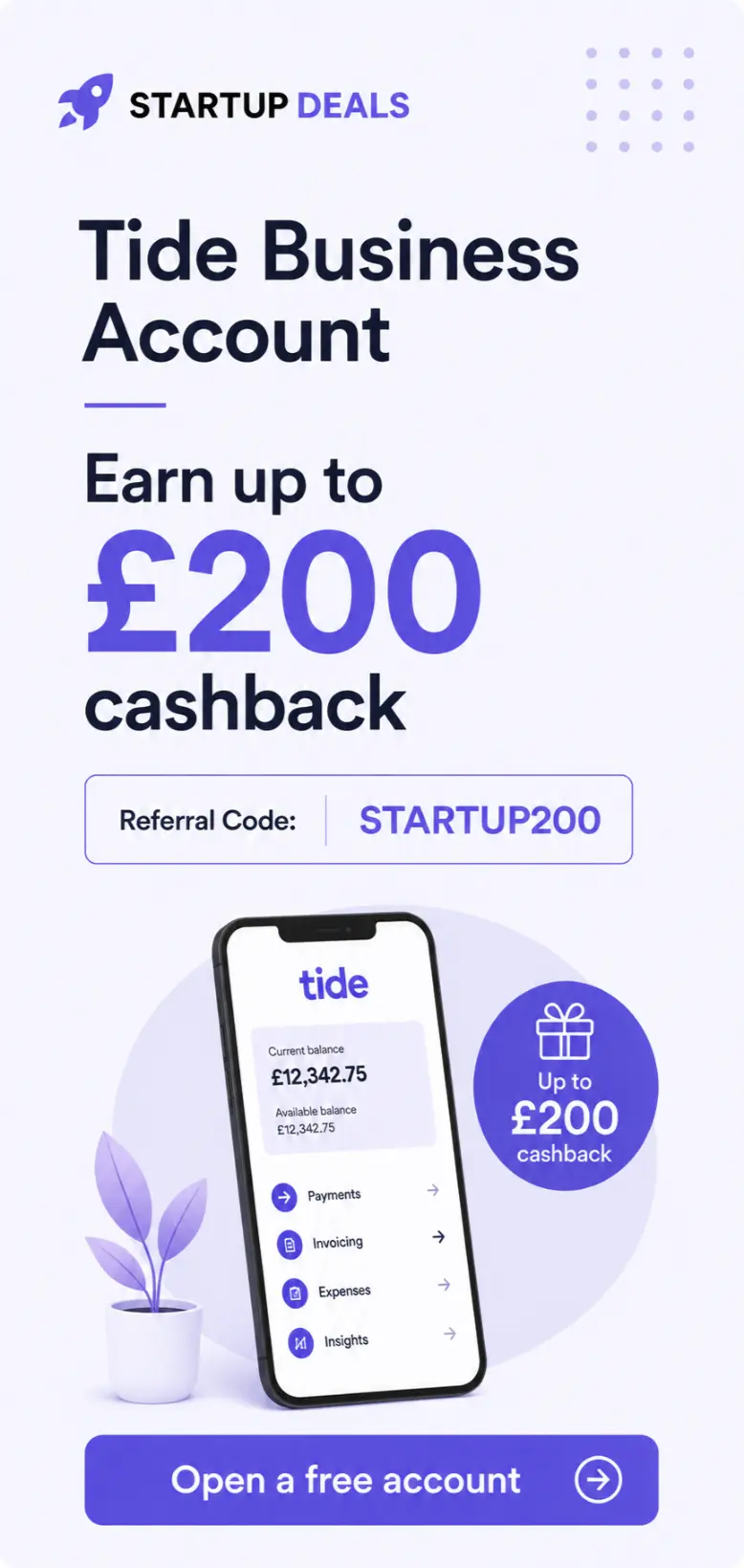
For eligible applicants, there is currently an opportunity to receive up to £200 in cashback when opening a Tide business account for sole traders and meeting specific promotional requirements.
If you’re planning to open a Tide sole trader account, this promotion may provide additional value alongside the platform’s business banking features. However, as with any financial promotion, it is important to understand the eligibility criteria and qualifying conditions before applying.
What Is the Offer?
Eligible customers can earn up to £200 cashback through two separate rewards:
- £75 cashback reward
- Additional £125 Tide Instant Saver reward
Combined, these incentives provide a maximum potential reward of £200.
How to Qualify
To participate, applicants must use the promotional code: STARTUP200
The code should be entered during the account registration process when applying for a Tide bank account for sole traders or another eligible Tide business account.
First Reward: £75 Cashback
To unlock the £75 cashback reward, eligible applicants must:
- Register their business and open a Tide account.
- Enter the code STARTUP200 during registration.
- Spend at least £100 using their Tide card within 30 days of opening the account.
Once the qualifying spend requirement has been satisfied and all eligibility criteria have been met, the cashback reward may be credited according to Tide’s promotional terms.
Second Reward: £125 Instant Saver Offer
Applicants may also qualify for an additional £125 reward by:
- Opening a Tide Instant Saver Account.
- Depositing at least £5,000 into the saver account within 7 days of opening.
- Maintaining the qualifying balance for one month.
Provided all promotional conditions are met, the additional reward may be paid in accordance with Tide’s offer terms.
Who Is the Offer Suitable For?
The promotion may be particularly attractive to sole traders, freelancers, startups, contractors, and small business owners who are already planning to switch or open a new business account.
Many prospective customers researching can a sole trader open a Tide account are pleased to discover that eligible sole traders can participate in the offer, subject to the relevant terms and conditions.
Important Disclaimer
Promotional offers are subject to eligibility criteria, verification checks, and Tide’s full terms and conditions. Cashback amounts, qualification requirements, and promotional availability may change at any time. Subject to change—check current T&Cs.
If you’d like to check eligibility and apply, you can do so here: https://startupdeals.co.uk/recommends/tide-business-current-account
Security and Regulation
Security is one of the most important considerations when choosing a business banking provider. Regardless of features, pricing, or promotions, business owners need confidence that their financial information and funds are protected appropriately. This is why questions such as is Tide good for sole traders often include concerns about regulation, safeguarding, and account security.
The Tide business account for sole traders operates within the UK’s regulated financial environment and must comply with relevant regulatory requirements. These obligations help ensure customer protection, financial crime prevention, and operational integrity.
Like other financial providers, Tide conducts identity verification and customer due diligence procedures during onboarding. While these checks may occasionally add extra steps to the application process, they play an important role in protecting both customers and the wider financial system.
A Tide sole trader account also benefits from security measures designed to protect account access and financial information. Mobile app security, authentication procedures, and account monitoring systems help reduce the risk of unauthorised activity.
Prospective customers frequently ask whether deposits are protected and how funds are held. The exact arrangements can vary depending on Tide’s banking partners and product structure at the time. As a result, applicants should always review the latest regulatory disclosures and customer protection information before opening an account.
The Tide bank account for sole traders is designed for modern digital banking, which means security features must balance protection with convenience. Mobile access, real-time notifications, and transaction monitoring help users stay informed about account activity while maintaining control over their finances.
Fraud prevention remains a major focus across the financial services industry. Tide uses various measures intended to detect unusual account activity and help protect customers from financial crime. Nevertheless, account holders should always follow good security practices, including safeguarding passwords and monitoring transactions regularly.
When evaluating is Tide good for sole traders, security credentials are an important part of the assessment. Many users are attracted to the platform’s convenience, but confidence in regulatory compliance and account protection is equally important.
Businesses should also remember that financial services regulations evolve over time. Reviewing the latest information provided directly by Tide ensures that you have the most accurate and up-to-date understanding of how accounts are protected.
For most sole traders, Tide provides a combination of modern digital banking functionality and regulatory compliance designed to support secure business banking in 2026.
General FAQs About Tide Business Account
Can a sole trader open a Tide account?
Yes. Eligible self-employed professionals can apply for a Tide sole trader account and access many of the same banking and business management features available to other business types.
Is Tide good for sole traders?
For many self-employed professionals, Tide offers useful banking, invoicing, bookkeeping, and expense management tools. Whether Tide is good for sole traders depends on your business needs and how you plan to use the platform.
What is a Tide business account for sole traders?
A Tide business account for sole traders is a dedicated business banking solution that helps separate personal and business finances while providing access to business management tools.
Does a Tide bank account for sole traders require a credit check?
Tide may perform eligibility and verification checks as part of the application process. Requirements can vary depending on the products or services being applied for.
How long does it take to open a Tide account?
Application times can vary, but many users complete the onboarding process significantly faster than with traditional business banking providers.
Can freelancers use a Tide sole trader account?
Yes. Freelancers are among the most common users of a Tide sole trader account due to the platform’s invoicing and financial management features.
Can contractors use a Tide business account for sole traders?
Yes. Contractors operating as sole traders can generally apply, subject to Tide’s eligibility and verification requirements.
Does Tide integrate with accounting software?
Yes. The Tide bank account for sole traders supports integrations with popular accounting platforms, helping streamline bookkeeping and administration.
Is Tide regulated in the UK?
Yes. Tide operates within the UK’s regulated financial services environment and must comply with applicable regulatory requirements.
Is Tide authorised by the FCA?
Tide operates within the UK financial regulatory framework. Applicants should review the latest regulatory disclosures and authorisation details provided by Tide directly.
FAQs About the Tide £200 Cashback Offer
What is the Tide cashback offer?
Eligible applicants can earn up to £200 through a combination of a £75 cashback reward and an additional £125 Instant Saver reward.
What referral code do I need to use?
You must enter the code STARTUP200 during the application process to qualify for the promotion, subject to the applicable terms.
Can a sole trader open a Tide account and receive the offer?
Yes. Eligible sole traders can participate in the promotion provided they satisfy all qualifying conditions and verification requirements.
How do I get the £75 cashback reward?
You must open an eligible account, enter the STARTUP200 code, and spend at least £100 on your Tide card within 30 days of opening the account.
How do I qualify for the £125 saver reward?
You must deposit at least £5,000 into a qualifying Tide Instant Saver Account within 7 days of opening and maintain the balance for one month.
Is the offer available on every Tide sole trader account?
Promotional eligibility can vary. Applicants should review the latest terms and conditions before opening a Tide sole trader account.
Does the £100 card spend have to be completed within a specific period?
Yes. The qualifying spend requirement must generally be completed within 30 days of account opening.
Can existing customers claim the offer?
Promotions are often aimed at new customers, although eligibility rules can change. Always check the current offer terms.
How long does cashback take to arrive?
Reward payment timings can vary depending on verification and promotional processing requirements.
Can I use the offer with a Tide bank account for sole traders?
Yes. Eligible applicants opening a Tide bank account for sole traders can qualify, subject to the relevant promotion terms.
Is the cashback guaranteed?
No. Applicants must meet all eligibility requirements, verification checks, and promotional conditions before any reward is paid.
Can the promotion change?
Yes. Offer amounts, qualifying criteria, deadlines, and availability may be amended or withdrawn by Tide at any time.
Where can I check the latest promotion details?
You can review the latest information and application requirements here: https://startupdeals.co.uk/recommends/tide-business-current-account
Recap
The Tide business account for sole traders has become one of the most popular digital business banking solutions available to UK self-employed professionals. Its combination of business banking functionality, invoicing tools, expense management features, accounting integrations, and mobile-first accessibility makes it particularly attractive for freelancers, contractors, consultants, and growing small businesses.
Throughout this guide, we’ve explored how a Tide sole trader account can help separate business and personal finances while simplifying everyday financial administration. We’ve also looked at the key features, pricing considerations, payment capabilities, accounting integrations, security measures, and eligibility requirements that prospective applicants should understand before opening an account.
For many business owners researching whether is Tide good for sole traders, the answer often comes down to convenience, automation, and the ability to manage multiple aspects of business finance through a single platform. The Tide bank account for sole traders is designed specifically to support modern business owners who value flexibility and digital efficiency.
Eligible applicants may also benefit from the current cashback promotion, which offers the opportunity to earn up to £200 when qualifying conditions are met.
To check the latest offer details and see whether you qualify, visit: https://startupdeals.co.uk/recommends/tide-business-current-account
Conclusion
Choosing the right business banking provider can have a significant impact on how efficiently you manage your finances, track expenses, monitor cash flow, and prepare for tax obligations. For many self-employed professionals, the Tide business account for sole traders offers a compelling combination of digital convenience and practical business management tools.
The platform goes beyond traditional banking by providing integrated invoicing, expense tracking, accounting software connectivity, and business finance features designed specifically for small businesses and self-employed individuals. These capabilities can help reduce administrative workloads and free up valuable time to focus on serving customers and growing your business.
If you’re currently comparing business banking options, a Tide sole trader account may be worth serious consideration. The ability to open an account online, manage finances through a mobile app, and access a growing ecosystem of business services makes Tide an attractive choice for many entrepreneurs.
For those still asking can a sole trader open a Tide account, the answer is yes for eligible applicants. Likewise, if you’re researching whether is Tide good for sole traders, many users find that the platform’s blend of flexibility, automation, and business-focused functionality provides substantial value.
The Tide bank account for sole traders is particularly well suited to freelancers, consultants, contractors, online sellers, and service-based businesses looking for a modern alternative to traditional business banking.
If you’d like to explore the latest promotion and potentially earn up to £200 in cashback, you can check eligibility and apply here: https://startupdeals.co.uk/recommends/tide-business-current-account
Offers are subject to eligibility requirements and may change without notice. Always review the latest terms and conditions before applying.
With the right banking solution in place, managing business finances becomes simpler, more organised, and more scalable. For many UK sole traders in 2026, Tide remains a strong option worth considering.
Latest Posts:
- Zempler Bank Review 2026: Is It Good Value for UK Startups?
 Introduction Zempler Bank offers a genuine UK business bank account from £0 per month, with app and online banking, Post Office cash deposits and built-in tools for invoicing, receipts and… Read more: Zempler Bank Review 2026: Is It Good Value for UK Startups?
 - Hoxton Mix vs Virtually There: Which Virtual Office Service Is Better?
 Introduction If you’re comparing Hoxton Mix vs Virtually There, you’re likely searching for a virtual office provider that offers the right balance of professionalism, affordability, and flexibility. Whether you’re launching… Read more: Hoxton Mix vs Virtually There: Which Virtual Office Service Is Better?
 - Hoxton Mix vs Icon Offices: Which Virtual Office Is Better?
 Introduction Choosing a virtual office provider can have a significant impact on how your business is perceived, how you manage your mail, and even how effectively you maintain privacy as… Read more: Hoxton Mix vs Icon Offices: Which Virtual Office Is Better?
 - 7 Powerful Benefits of Using a Hoxton Mix Virtual Office Address
 Introduction For startups, freelancers, sole traders and growing SMEs, establishing a professional business presence can be challenging. Renting physical office space in London is often expensive, particularly during the early… Read more: 7 Powerful Benefits of Using a Hoxton Mix Virtual Office Address
 - Hoxton Mix Review: Features, Pricing, Pros and Cons Explained
 Introduction If you’re searching for an honest and detailed hoxton mix review, you’re likely comparing virtual office providers and trying to decide whether Hoxton Mix offers good value for your… Read more: Hoxton Mix Review: Features, Pricing, Pros and Cons Explained
 - Hoxton Mix Virtual Office Discount: Save 10% on Your First 12 Months
 Introduction If you’re looking for a professional London business address without the cost of renting physical office space, a Hoxton Mix Virtual Office discount could help you reduce your startup… Read more: Hoxton Mix Virtual Office Discount: Save 10% on Your First 12 Months
 - Tide Referral Code 2026: Powerful Guide to Claim £200 Cashback with STARTUP200
 Introduction If you’re looking for a Tide referral code in 2026, you’re probably searching for the best possible deal before opening a business account. Whether you’re a sole trader, freelancer,… Read more: Tide Referral Code 2026: Powerful Guide to Claim £200 Cashback with STARTUP200
 - Tide vs High Street Banks: Powerful 2026 Review
 Introduction Choosing the right business banking solution is one of the most important decisions a UK business owner can make. Whether you’re a sole trader, freelancer, contractor, startup founder, or… Read more: Tide vs High Street Banks: Powerful 2026 Review
 - Tide Business Account for Tradespeople | Powerful Guide 2026
 Introduction Running a trade business involves much more than completing jobs and keeping customers happy. Whether you’re a plumber, electrician, builder, carpenter, roofer, landscaper, painter, heating engineer, or general contractor,… Read more: Tide Business Account for Tradespeople | Powerful Guide 2026