

Introduction
Starting a new business comes with countless decisions, and choosing the right banking provider is one of the most important. Whether you’re launching a limited company, side hustle, ecommerce venture, consultancy, or technology startup, having a dedicated business account can help separate personal and business finances while giving you access to tools designed specifically for growing companies.
For many UK founders, a Tide business account for startups has become one of the most popular options available. Unlike traditional high-street banks that often require lengthy application processes and branch visits, Tide offers a digital-first banking experience designed for modern entrepreneurs. Account opening is typically fast, the mobile app is intuitive, and startups can access a range of financial management tools from day one.
If you’re considering opening a business account, Tide business banking for startups is frequently mentioned alongside providers such as Monzo Business and Starling Business. The platform has built a strong reputation among founders looking for a straightforward solution that combines business banking, expense management, invoicing, and accounting integrations in a single place.
New businesses are often looking for ways to reduce administrative workload while maintaining visibility over cash flow. A Tide startup account can help simplify these tasks by providing real-time transaction notifications, invoice creation tools, and integrations with popular accounting software. These features can be particularly valuable during the early stages of growth when founders are balancing multiple responsibilities.
If you’re ready to open an account, eligible businesses may also be able to benefit from the current promotional offer available through Startup Deals: https://startupdeals.co.uk/recommends/tide-business-current-account
Throughout this guide, we’ll explain exactly how Tide works, who it is suitable for, its advantages and disadvantages, how it compares with competitors, and answer the common question: is Tide good for startups? We’ll also examine fees, account features, cashback opportunities, and the current promotional offer available to new customers.
By the end of this guide, you’ll have a clear understanding of whether Tide banking for startups is the right choice for your business in 2026.
Contents:
- Who Is Tide?
- Tide Business Account for Ltd Companies
- Who Can Use Tide?
- Key Benefits of Tide
- Features and Tools
- Fees and Pricing
- How to Open an Account
- Tide Cashback Offer
- Tide vs Competitors
- Pros and Cons
- Is It Worth It?
- General FAQs
- Offer FAQs
- Recap
- Conclusion
Who Is Tide?
Tide is a UK-based financial technology company that provides business financial services designed specifically for small businesses, sole traders, freelancers, contractors, and startup founders. Since launching, the company has grown significantly and now serves hundreds of thousands of UK businesses seeking a modern alternative to traditional business banking.
Unlike conventional banks, Tide focuses heavily on digital convenience. Businesses can manage their finances primarily through a mobile application and web dashboard, eliminating much of the paperwork traditionally associated with business banking. This digital-first approach has made Tide particularly attractive to entrepreneurs launching new ventures and seeking efficient financial management tools.
One reason many founders choose Tide business banking for startups is the speed and simplicity of the onboarding process. Traditional banks may require extensive documentation, in-person appointments, and lengthy approval periods. Tide has streamlined much of this process, helping eligible businesses get up and running quickly.
The platform provides a range of services beyond basic banking functionality. Users can send and receive payments, create invoices, track expenses, manage cash flow, and connect their account with accounting software. These additional features can save startup founders valuable time while reducing manual administrative work.
A Tide startup account can be particularly useful during the early stages of business development. Many founders operate with limited resources and small teams. Having financial tools integrated into one platform can improve efficiency and allow entrepreneurs to focus on business growth rather than administrative tasks.
Another factor contributing to Tide’s popularity is its flexible account structure. Businesses can choose from different account tiers depending on their needs. This allows startups to begin with a simple solution and potentially upgrade as their business expands and financial requirements become more complex.
Security and compliance are also important considerations. Tide operates within UK financial regulations and uses security measures designed to protect customer information and account activity. Businesses should always review current regulatory information directly from Tide when evaluating any financial provider.
For founders asking “is Tide good for startups”, understanding Tide’s target audience is important. The platform was built specifically with small businesses and entrepreneurs in mind, rather than large corporations requiring highly specialised banking infrastructure. As a result, many startup-specific challenges are addressed through features tailored to growing businesses.
Ultimately, Tide’s combination of accessibility, digital convenience, financial management tools, and startup-focused services explains why it continues to attract founders looking for a practical banking solution in 2026.

Why Choose a Tide Business Account for Startups?
A Tide business account for startups offers several advantages that appeal directly to founders launching new ventures. During the startup phase, businesses typically prioritise speed, simplicity, affordability, and flexibility. Tide has positioned its services around these exact requirements.
One of the primary reasons entrepreneurs choose Tide banking for startups is the streamlined setup process. New businesses often need an operational account quickly so they can receive customer payments, pay suppliers, and manage expenses. Delays in opening a business account can slow down business operations, making fast onboarding highly valuable.
Another major benefit is accessibility. Because Tide operates digitally, founders can manage their finances from virtually anywhere. Whether working from home, a co-working space, or travelling between client meetings, users can access financial information through the Tide app or online dashboard.
The feature set is another key advantage. A Tide startup account includes tools that extend beyond basic banking functionality. Businesses can generate invoices, categorise spending, monitor cash flow, and integrate accounting software. These features help founders maintain greater visibility over financial performance during the critical early growth phase.
Cost management is particularly important for startups. Many founders operate with limited budgets and seek solutions that provide value without unnecessary complexity. Tide offers options designed to accommodate businesses at different stages, allowing founders to select an account structure that aligns with their operational requirements.
Real-time notifications are another practical benefit. Startup owners often need immediate visibility of incoming payments and outgoing expenses. Instant transaction updates can help improve cash flow monitoring and reduce the likelihood of missed financial activity.
The ecosystem surrounding Tide business banking for startups also contributes to its appeal. In addition to banking features, businesses can access tools designed to simplify administration and improve operational efficiency. Reducing manual financial tasks can free up time for customer acquisition, product development, and strategic growth initiatives.
For businesses looking to maximise value, the current cashback promotion may provide additional incentives for eligible applicants. New customers who meet qualifying requirements may be able to earn cashback rewards while establishing their business banking setup.
Another reason founders ask “is Tide good for startups” relates to scalability. While many startups begin with modest transaction volumes, their requirements often grow quickly. Tide’s range of account options allows businesses to adapt as they expand without necessarily changing banking providers.
Overall, the combination of digital convenience, startup-focused tools, streamlined onboarding, and business management features makes Tide a compelling option for entrepreneurs launching new ventures in the UK. For many founders, a Tide business account for startups provides a practical balance between functionality, affordability, and ease of use.
Who Can Use Tide?
Choosing the right business banking provider starts with understanding whether the service is available to your business type. One reason Tide has become popular among founders is its broad appeal across different business structures. Whether you are launching a new side project or building a venture-backed company, a Tide startup account may be suitable depending on your circumstances.
Tide is commonly used by sole traders, freelancers, contractors, consultants, limited companies, and small businesses. This flexibility makes it attractive to entrepreneurs who may begin trading as sole traders before eventually incorporating as limited companies. Because startup journeys often evolve rapidly, having a provider that can support different business models can be beneficial.
For limited company founders, Tide business banking for startups provides an efficient way to separate business and personal finances from day one. This separation is particularly important for bookkeeping, tax reporting, and maintaining professional financial records. Investors, accountants, and lenders often expect businesses to have dedicated company banking arrangements in place.
Freelancers and self-employed professionals can also benefit from a Tide startup account. Many freelancers struggle with expense tracking and invoice management during their first few years of trading. Tide includes tools that can help streamline these processes while maintaining a clear record of business income and expenditure.
Ecommerce businesses are another group frequently attracted to Tide banking for startups. Online retailers often require fast payment processing, easy transaction tracking, and visibility over cash flow. Having immediate access to financial information can support inventory planning, supplier payments, and growth decisions.
Technology startups may also find value in Tide’s digital-first approach. Founders who already rely on cloud-based software, remote working, and digital operations often appreciate banking tools that fit naturally into their existing workflows. The ability to manage finances through a mobile app aligns well with modern startup operating models.
Agency owners, consultants, digital marketers, designers, developers, and content creators also represent a large segment of Tide users. These businesses typically prioritise simplicity and efficiency over complex corporate banking structures, making Tide a practical choice during early growth stages.
Eligibility requirements may vary depending on business type, ownership structure, and regulatory considerations. Applicants should always review the latest requirements before applying. Some businesses may be required to provide additional documentation during the verification process.
When founders ask, “is Tide good for startups?”, eligibility is often one of the first considerations. The answer for many UK-based entrepreneurs is yes, provided their business falls within the supported categories and meets account opening requirements.
Ultimately, Tide’s broad accessibility helps explain why so many startups choose it as their first business banking solution. From freelancers and sole traders to incorporated startups and growing SMEs, the platform caters to a wide range of entrepreneurial journeys.
Key Benefits for Startups
A major reason founders consider a Tide business account for startups is the range of practical benefits available during the critical early stages of growth. New businesses often face resource constraints, administrative challenges, and cash flow pressures. The right banking platform can help reduce some of these burdens while supporting efficient financial management.
One of the most significant benefits is convenience. Traditional banking processes can sometimes be slow and paperwork-heavy. By contrast, Tide business banking for startups focuses on simplicity and accessibility, allowing founders to manage finances digitally from almost anywhere. This can be particularly valuable for entrepreneurs balancing multiple responsibilities.
Speed is another important advantage. Startups frequently need to begin receiving customer payments quickly after launch. Faster account setup and onboarding can reduce delays and allow businesses to start trading sooner. For founders operating under tight timelines, this efficiency can make a meaningful difference.
Cash flow visibility is equally important. Many startups fail due to poor cash flow management rather than lack of demand. A Tide startup account provides real-time transaction updates that help business owners monitor incoming revenue and outgoing expenses. This visibility supports better financial decision-making and forecasting.
Expense management tools can also help reduce administrative workloads. Instead of manually reviewing transactions at month-end, founders can categorise spending throughout the month and maintain more organised records. This can save time while simplifying bookkeeping processes.
Another benefit is professional credibility. Customers, suppliers, and partners often expect businesses to operate using dedicated business accounts. A separate account helps demonstrate professionalism and creates a clearer distinction between personal and business finances.
Accounting integrations represent another valuable feature. Many startups rely on software platforms for bookkeeping and tax management. Connecting financial data directly with accounting systems can reduce manual data entry and improve record accuracy. This can become increasingly important as transaction volumes grow.
Flexibility is also a key consideration. Business needs often change rapidly during the startup phase. Tide banking for startups offers different account options that allow founders to choose a level of service appropriate to their current stage while maintaining room for future growth.
Many entrepreneurs are also attracted by promotional incentives. Eligible customers may qualify for cashback rewards through available offers, potentially adding extra value during the account opening process. While incentives should never be the sole reason for choosing a provider, they can provide a welcome boost for startups managing limited budgets.
For founders evaluating whether Tide business banking for startups aligns with their goals, these benefits help explain its growing popularity. The combination of convenience, financial visibility, automation, flexibility, and startup-focused functionality makes it an appealing option for many new businesses across the UK.
Important Features of a Tide Startup Account
Understanding the available features is essential when comparing business banking providers. A Tide startup account includes a range of tools designed to help founders manage finances more effectively while reducing administrative complexity.
One of the most widely used features is real-time transaction monitoring. Every payment, transfer, and expense can be viewed quickly through the Tide app, helping business owners maintain visibility over financial activity. This level of transparency is particularly useful for startups that need to monitor cash flow closely.
Invoice creation tools are another valuable component of Tide business banking for startups. Many founders spend significant time creating and managing invoices manually. Tide allows businesses to generate invoices directly through the platform, helping streamline billing processes and potentially improving payment collection efficiency.
Expense tracking is equally important. Startups often accumulate numerous small business expenses that can become difficult to monitor. By categorising transactions and maintaining organised records, founders can simplify bookkeeping and improve financial reporting accuracy.
The Tide app serves as a central hub for account management. Entrepreneurs can check balances, review transactions, make payments, and manage various financial tasks from a mobile device. This convenience supports flexible working arrangements and enables founders to stay connected to business finances while on the move.
Accounting software integrations are another notable feature. Many businesses use cloud accounting platforms to manage tax obligations and financial reporting. A Tide startup account can connect with popular accounting tools, reducing duplication of effort and helping maintain consistent financial records.
Business debit cards provide additional flexibility. Founders and authorised team members can make business purchases while keeping expenses separate from personal spending. This separation supports cleaner bookkeeping and improved financial management.
Payment functionality also plays a significant role. Businesses can receive customer payments, pay suppliers, transfer funds, and manage routine transactions through the platform. Efficient payment management helps support day-to-day operations and business growth.
Security remains a key consideration for any financial provider. Tide banking for startups includes security measures designed to protect account access and transaction activity. Founders should still follow good security practices, including strong passwords and account monitoring.
Many entrepreneurs researching “is Tide good for startups” focus heavily on the feature set. The combination of banking services, invoicing, expense management, accounting integrations, and mobile accessibility makes Tide particularly attractive to businesses seeking an all-in-one financial management solution.
As startups grow, these features can help reduce administrative workloads, improve visibility over finances, and support more informed decision-making. For many founders, this practical functionality represents one of Tide’s strongest advantages.
How to Open a Tide Business Account: Step-by-Step Guide
Opening a business account is often one of the first financial tasks a founder completes after starting a business. Fortunately, one of the main attractions of a Tide business account for startups is the relatively straightforward application process. Unlike some traditional banking providers that may require branch appointments and extensive paperwork, Tide uses a digital onboarding experience designed to help businesses get started efficiently.
The first step is to visit the Tide website or download the Tide mobile application. Prospective customers can begin the application process directly from their chosen device. During registration, applicants will typically be asked to provide personal details, business information, and verification documentation.
If your business is a limited company, you’ll usually need information relating to the company itself, including registration details and ownership information. Sole traders and freelancers may have slightly different requirements. Having these documents ready in advance can help streamline the application process.
The verification stage is an important part of the onboarding journey. Financial service providers must comply with regulatory requirements, meaning identity and business checks are often necessary. Founders should ensure the information provided is accurate and matches official documentation to avoid unnecessary delays.
After submitting the application, Tide will review the information supplied. Approval times can vary depending on the complexity of the application and whether additional information is required. Many founders choose Tide business banking for startups because the process is often considerably faster than traditional alternatives.
Once approved, customers can access their account through the mobile app and online dashboard. This enables businesses to begin receiving payments, managing expenses, and using the various tools included with their chosen account plan.
New customers interested in promotional rewards should also pay close attention to any qualifying requirements. If applying through an offer, there may be deadlines relating to account opening, spending activity, or savings deposits that must be met to qualify for rewards.
A Tide startup account becomes particularly useful once operational activities begin. Founders can issue invoices, monitor cash flow, make payments, and track expenses from a single platform. These capabilities can help establish strong financial processes from the earliest stages of business development.
For entrepreneurs wondering “is Tide good for startups”, the onboarding experience is often a major advantage. The ability to complete much of the process digitally can save valuable time and reduce friction during business setup.
Ultimately, while eligibility requirements and approval timelines vary between applicants, Tide’s digital application process remains one of the key reasons many UK startups choose the platform as their business banking provider.
Tide Fees and Costs Explained
Understanding fees is essential before opening any business account. Startups are often highly cost-conscious, and selecting a banking provider with transparent pricing can help support better financial planning. Fortunately, Tide offers multiple account options designed to accommodate businesses at different stages of growth.
A Tide startup account may be available with a range of pricing structures depending on the plan selected. Businesses can often choose between entry-level options and more feature-rich premium plans. The most appropriate choice depends on transaction volume, operational requirements, and desired account features.
While many founders focus primarily on monthly account fees, it’s equally important to consider transaction-related charges. Businesses should review costs associated with transfers, cash deposits, international transactions, and other banking activities that may be relevant to their operations.
For startups with relatively low transaction volumes, entry-level plans may provide sufficient functionality. However, businesses expecting rapid growth or requiring advanced financial management features may find additional value in upgraded account tiers.
One advantage of Tide business banking for startups is the transparency surrounding account options. Rather than navigating complex fee structures commonly associated with traditional business banking, founders can typically compare available plans and determine which option best matches their needs.
Another factor to consider is scalability. A startup may begin with modest banking requirements but quickly outgrow a basic account. Selecting a provider capable of supporting future growth can help avoid unnecessary account migrations later.
In addition to standard banking costs, founders should consider the value of integrated tools. Features such as invoicing, expense tracking, accounting integrations, and financial reporting may reduce administrative workload and offset costs that might otherwise require separate software subscriptions.
Cash deposit fees can be particularly relevant for businesses that handle physical cash. Retailers, hospitality businesses, and certain service providers should evaluate these costs carefully when comparing banking providers.
Entrepreneurs often ask, “is Tide good for startups when considering costs?” The answer depends largely on individual business needs. Some startups prioritise low fees above all else, while others place greater value on automation, convenience, and integrated financial management tools.
Ultimately, the best approach is to compare available account plans against your expected usage patterns. By understanding transaction volumes, payment requirements, and desired features, founders can determine whether a Tide business account for startups represents good value for their specific circumstances.
Tide vs Competitors: How Does Tide Compare?
Choosing the right banking provider often involves comparing several alternatives. While Tide has become one of the UK’s most popular fintech business banking solutions, founders should still evaluate how it compares against competitors before making a decision.
The most common alternatives include Monzo Business, Starling Business, and traditional high-street banking providers. Each option offers different strengths depending on the needs of the startup.
One area where Tide business banking for startups performs strongly is its focus on small businesses and entrepreneurs. Many of its features are designed specifically to address common startup challenges such as invoicing, expense management, and accounting integration. This targeted approach has helped Tide build a loyal customer base among founders.
Monzo Business is often viewed as a strong competitor due to its user-friendly interface and growing ecosystem of business tools. Some founders prefer Monzo’s consumer banking heritage, while others favour Tide’s startup-focused functionality.
Starling Business is another major competitor. It has earned a reputation for offering a robust business banking experience with competitive features. Startups comparing Starling and Tide should evaluate factors such as account fees, integrations, available tools, and overall user experience.
Traditional banks remain relevant for certain businesses. Companies with complex banking requirements, extensive borrowing needs, or significant international operations may still prefer established banking institutions. However, many startups find fintech providers more agile and easier to work with during their early growth stages.
A Tide startup account often appeals to founders who prioritise efficiency and automation. Features such as invoice creation, instant notifications, and integrated expense management can simplify financial administration significantly.
When comparing providers, startups should consider more than headline pricing. Customer support, account accessibility, software integrations, scalability, and ease of use can all have a meaningful impact on daily operations.
The question “is Tide good for startups” frequently arises when entrepreneurs compare available options. In many cases, the answer depends on business priorities. Founders seeking straightforward digital banking with integrated management tools often find Tide highly attractive.
No single provider is perfect for every business. The best choice depends on company structure, transaction volumes, operational requirements, and growth plans. Taking time to compare available options carefully can help ensure the chosen banking provider supports long-term success.
Cash Flow and Accounting Tools for Growing Startups
Cash flow management is one of the most important responsibilities facing startup founders. Even profitable businesses can encounter difficulties if cash flow is poorly managed. This is one reason many entrepreneurs choose a Tide business account for startups, as the platform includes several tools designed to improve financial visibility and control.
Real-time transaction monitoring provides founders with immediate insight into business activity. Instead of waiting for monthly statements, businesses can view payments and expenses as they occur. This allows for quicker decision-making and improved financial awareness.
Invoice management tools are another significant advantage. Many startups rely heavily on prompt customer payments to maintain healthy cash flow. By generating invoices directly through the platform, businesses can streamline billing processes and maintain organised financial records.
Expense tracking functionality also supports stronger financial management. Categorising transactions throughout the month helps businesses understand spending patterns and identify areas where costs can potentially be reduced. This information can be valuable when preparing budgets or forecasting future growth.
Accounting integrations are particularly important for startups seeking efficient financial administration. A Tide startup account can connect with popular accounting software, helping automate data transfers and reduce manual bookkeeping tasks. This not only saves time but may also improve reporting accuracy.
Financial visibility becomes increasingly important as businesses grow. Founders often begin by managing finances personally but eventually need systems capable of supporting larger transaction volumes and more complex operations. Tide banking for startups offers tools that can scale alongside business development.
The ability to access financial information from a mobile device is another practical benefit. Entrepreneurs frequently work remotely, travel between meetings, or manage teams across multiple locations. Mobile access ensures key financial information remains available whenever needed.
Forecasting is another area where visibility can provide substantial value. Understanding current cash flow trends can help founders make informed decisions regarding hiring, investment, inventory purchases, and expansion opportunities.
When founders ask “is Tide good for startups”, cash flow management tools are often highlighted as a major strength. Having access to integrated financial data and operational insights can reduce administrative burdens while improving financial decision-making.
For startups focused on sustainable growth, maintaining visibility over cash flow and financial performance is essential. Tide’s integrated tools help support this objective while providing practical functionality that many modern businesses value highly.
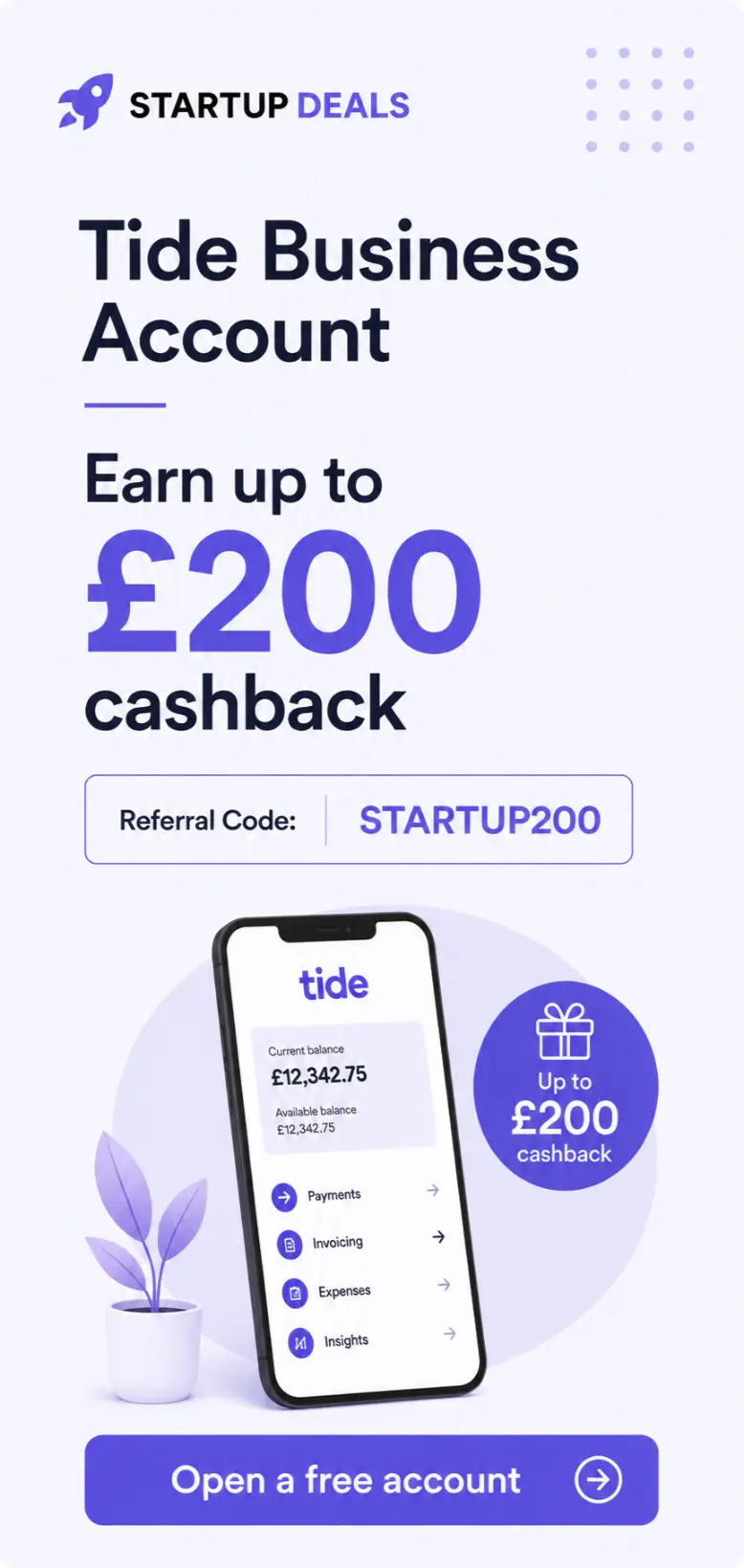
Earn up to £200 Cashback with the Tide Startup Offer
For many founders, choosing a business banking provider is not only about features and functionality but also about maximising value during the early stages of growth. Eligible applicants opening a Tide business account for startups may currently be able to benefit from a promotional cashback offer worth up to £200.
This offer is designed to reward new customers who open and actively use their account shortly after registration. While the banking features themselves may be the primary reason for choosing Tide business banking for startups, the cashback incentive can provide an additional financial boost for new businesses.
The current promotion is split into two separate rewards.
The first reward is worth £75 cashback. To qualify, you must use the referral code STARTUP200 when registering your business and opening your Tide account. After the account is successfully opened, you must spend at least £100 using your Tide business debit card within the first 30 days.
Once the qualifying spending requirement has been met, eligible customers can receive the £75 cashback reward.
The second reward is worth an additional £125 and is linked to Tide’s Instant Saver product.
To qualify for this additional reward, eligible customers must deposit at least £5,000 into a Tide Instant Saver Account within seven days of opening their business account. The qualifying balance must then remain in the savings account for at least one month.
Customers who satisfy both sets of requirements may be eligible to receive the full £200 reward.
Offer Summary
- Referral code: STARTUP200
- Open a qualifying Tide startup account
- Spend £100 on your Tide business debit card within 30 days
- Receive £75 cashback (subject to eligibility)
- Deposit £5,000 into Tide Instant Saver within 7 days
- Maintain the balance for one month
- Receive an additional £125 reward (subject to eligibility)
If you’re planning to open an account, you can use the offer link below: https://startupdeals.co.uk/recommends/tide-business-current-account
Startups should carefully review the latest promotion details before applying. Cashback offers can be updated, amended, extended, or withdrawn by the provider at any time.
As with all financial promotions, eligibility criteria apply and rewards are not guaranteed. Businesses should choose a provider based primarily on suitability rather than incentives alone.
Offer subject to change—check current T&Cs.
Is Tide Good for Startups?
One of the most common questions founders ask before opening an account is: is Tide good for startups?
For many UK entrepreneurs, the answer is yes. Tide has built its reputation around supporting small businesses, sole traders, freelancers, and startup founders through a combination of digital banking tools, financial management features, and streamlined onboarding.
A key advantage of Tide business banking for startups is convenience. Founders can manage payments, expenses, invoicing, and cash flow from a single platform. This can reduce administrative burden and free up time for revenue-generating activities.
The platform’s digital-first approach is particularly attractive to modern businesses. Rather than relying on branch visits and paperwork, entrepreneurs can access most banking functions through the mobile app or online dashboard. This flexibility aligns well with the needs of remote-first and technology-focused startups.
The Tide startup account also includes features that many founders find valuable during the early stages of business growth. Real-time transaction notifications, invoice creation, accounting integrations, and expense tracking all contribute to improved financial visibility and organisation.
Cost is another important consideration. Tide offers various account options that allow businesses to select a plan suitable for their current requirements. This flexibility can be beneficial for startups seeking a balance between affordability and functionality.
However, no banking solution is perfect for every business. Companies with highly specialised banking needs, extensive international operations, or complex lending requirements may wish to compare multiple providers before making a decision.
When evaluating whether Tide banking for startups is right for your business, it’s important to consider your operational requirements, transaction volumes, software preferences, and growth plans. What works well for one founder may not necessarily be the best solution for another.
Overall, many entrepreneurs find that Tide offers a strong combination of usability, accessibility, automation, and startup-focused functionality. This explains why it continues to be one of the most widely discussed business banking providers among UK startups.
If your goal is to access straightforward business banking combined with practical financial management tools, a Tide business account for startups may be well worth considering.
General FAQs About Tide Business Account
Does Tide offer a business account for startups?
Yes. A Tide business account for startups is designed to support new businesses, sole traders, freelancers, and limited companies looking for digital business banking.
What is a Tide startup account?
A Tide startup account is a business banking solution that provides payment services, invoicing tools, expense management, and accounting integrations for growing businesses.
Is Tide good for startups?
Many founders believe Tide business banking for startups offers a strong combination of convenience, digital tools, and financial visibility suitable for early-stage businesses.
Can sole traders use Tide?
Yes. Sole traders, freelancers, contractors, and consultants can apply for a Tide startup account if they meet eligibility requirements.
Can limited companies open a Tide account?
Yes. Many limited companies use Tide banking for startups to manage business finances separately from personal accounts.
Does Tide provide debit cards?
Yes. Eligible account holders receive a business debit card that can be used for qualifying business purchases and expenses.
Does Tide integrate with accounting software?
Yes. Tide business banking for startups supports integrations with various accounting platforms to simplify bookkeeping and financial management.
Can startups send invoices through Tide?
Yes. A Tide startup account includes invoicing features that can help businesses generate and manage customer invoices more efficiently.
Is Tide regulated?
Tide is regulated by the FCA and operates within UK financial regulations and works with regulated banking partners. Businesses should always review the latest regulatory information directly from Tide.
Can startups manage their accounts through a mobile app?
Yes. Tide banking for startups is designed around mobile and online account management, allowing founders to access their finances wherever they are.
FAQs About the Tide £200 Cashback Offer
What referral code should I use?
Use the referral code STARTUP200 when opening your Tide business account for startups.
How much cashback can I earn?
Eligible customers may earn up to £200 through the current Tide startup account promotion.
How do I qualify for the £75 cashback?
Spend at least £100 on your Tide business debit card within 30 days of opening your qualifying account.
How do I qualify for the additional £125 reward?
Deposit at least £5,000 into a Tide Instant Saver account within seven days and keep the balance there for one month.
Can existing customers claim the offer?
Promotional offers are generally aimed at new customers, although eligibility rules should always be checked before applying.
How quickly must I spend £100?
The qualifying card spend must usually be completed within 30 days of opening the account.
Is the £5,000 deposit requirement mandatory?
Only customers seeking the additional £125 reward need to satisfy the savings requirement.
Can I withdraw the savings balance early?
Removing funds before the qualifying period ends may affect eligibility for the £125 reward.
Is the offer available to all business types?
Eligibility may vary depending on business structure and application approval criteria.
Where can I claim the offer?
You can apply through: https://startupdeals.co.uk/recommends/tide-business-current-account
Do I need to enter STARTUP200 manually?
Yes. To maximise eligibility, ensure STARTUP200 is entered during the registration process where applicable.
Is the cashback guaranteed?
Cashback is subject to eligibility checks and successful completion of all qualifying conditions.
Recap
If you’re looking for a modern business banking solution designed specifically for entrepreneurs, a Tide business account for startups is certainly worth considering. Throughout this guide, we’ve explored how Tide supports new businesses through a combination of digital banking services, invoicing tools, expense management features, accounting integrations, and mobile-first account access.
One of the biggest advantages of Tide business banking for startups is its focus on simplicity. Founders can apply online, manage finances from a single platform, and access tools that help reduce the administrative burden often associated with running a business. Whether you’re a sole trader launching your first venture or a limited company preparing for growth, Tide offers features that can help improve financial organisation and visibility.
We’ve also looked at the available account functionality, including real-time transaction monitoring, payment management, invoicing, and integrations with accounting software. These features can save valuable time and help founders maintain better control over cash flow during the critical early stages of business growth.
For eligible applicants, the current promotional offer may add further value. New customers who use the STARTUP200 referral code and meet the qualifying conditions could earn up to £200 in cashback rewards, subject to eligibility and current terms.
If you’re ready to explore your options and see whether Tide is suitable for your business, you can review the latest offer and application details here:
https://startupdeals.co.uk/recommends/tide-business-current-account
Conclusion
Choosing the right business banking provider can have a meaningful impact on the efficiency and financial management of your startup. While every business has different requirements, Tide has positioned itself as one of the most popular choices for UK entrepreneurs by combining accessible business banking with practical tools designed to support growing companies.
A Tide business account for startups offers much more than basic banking functionality. Founders gain access to features that can help simplify invoicing, track expenses, monitor cash flow, and integrate financial data with accounting software. For many businesses, these capabilities can reduce administrative workloads and allow more time to focus on growth, customer acquisition, and product development.
The platform’s digital-first approach is particularly appealing for modern founders who want the flexibility to manage business finances from anywhere. Combined with multiple account options and startup-focused functionality, Tide continues to be a strong contender in the UK’s business banking market.
For entrepreneurs still asking, “is Tide good for startups?”, the answer will ultimately depend on your specific needs. However, for many sole traders, freelancers, limited companies, and early-stage businesses, Tide provides a compelling balance of convenience, functionality, and accessibility.
If you’re considering opening an account, it’s worth reviewing the latest cashback promotion while it’s available. Eligible applicants who use the referral code STARTUP200 and satisfy the qualifying conditions may be able to earn up to £200 in rewards, subject to the provider’s terms and conditions.
To check the latest eligibility criteria, account options, and promotional details, apply here: https://startupdeals.co.uk/recommends/tide-business-current-account
Latest Posts:
- Zempler Bank Review 2026: Is It Good Value for UK Startups?
 Introduction Zempler Bank offers a genuine UK business bank account from £0 per month, with app and online banking, Post Office cash deposits and built-in tools for invoicing, receipts and… Read more: Zempler Bank Review 2026: Is It Good Value for UK Startups?
 - Hoxton Mix vs Virtually There: Which Virtual Office Service Is Better?
 Introduction If you’re comparing Hoxton Mix vs Virtually There, you’re likely searching for a virtual office provider that offers the right balance of professionalism, affordability, and flexibility. Whether you’re launching… Read more: Hoxton Mix vs Virtually There: Which Virtual Office Service Is Better?
 - Hoxton Mix vs Icon Offices: Which Virtual Office Is Better?
 Introduction Choosing a virtual office provider can have a significant impact on how your business is perceived, how you manage your mail, and even how effectively you maintain privacy as… Read more: Hoxton Mix vs Icon Offices: Which Virtual Office Is Better?
 - 7 Powerful Benefits of Using a Hoxton Mix Virtual Office Address
 Introduction For startups, freelancers, sole traders and growing SMEs, establishing a professional business presence can be challenging. Renting physical office space in London is often expensive, particularly during the early… Read more: 7 Powerful Benefits of Using a Hoxton Mix Virtual Office Address
 - Hoxton Mix Review: Features, Pricing, Pros and Cons Explained
 Introduction If you’re searching for an honest and detailed hoxton mix review, you’re likely comparing virtual office providers and trying to decide whether Hoxton Mix offers good value for your… Read more: Hoxton Mix Review: Features, Pricing, Pros and Cons Explained
 - Hoxton Mix Virtual Office Discount: Save 10% on Your First 12 Months
 Introduction If you’re looking for a professional London business address without the cost of renting physical office space, a Hoxton Mix Virtual Office discount could help you reduce your startup… Read more: Hoxton Mix Virtual Office Discount: Save 10% on Your First 12 Months
 - Tide Referral Code 2026: Powerful Guide to Claim £200 Cashback with STARTUP200
 Introduction If you’re looking for a Tide referral code in 2026, you’re probably searching for the best possible deal before opening a business account. Whether you’re a sole trader, freelancer,… Read more: Tide Referral Code 2026: Powerful Guide to Claim £200 Cashback with STARTUP200
 - Tide vs High Street Banks: Powerful 2026 Review
 Introduction Choosing the right business banking solution is one of the most important decisions a UK business owner can make. Whether you’re a sole trader, freelancer, contractor, startup founder, or… Read more: Tide vs High Street Banks: Powerful 2026 Review
 - Tide Business Account for Tradespeople | Powerful Guide 2026
 Introduction Running a trade business involves much more than completing jobs and keeping customers happy. Whether you’re a plumber, electrician, builder, carpenter, roofer, landscaper, painter, heating engineer, or general contractor,… Read more: Tide Business Account for Tradespeople | Powerful Guide 2026