

Introduction
Choosing the right business banking solution is one of the most important decisions a UK business owner can make. Whether you’re a sole trader, freelancer, contractor, startup founder, or limited company director, the bank account you choose can have a direct impact on your cash flow management, expenses, bookkeeping efficiency, and day-to-day administration.
The debate around Tide vs high street banks has become increasingly relevant as more businesses move towards digital-first banking solutions. Traditional banks have dominated the UK business banking market for decades, offering branch access, established reputations, and a wide range of financial services. However, newer fintech providers such as Tide have challenged the status quo by providing faster account opening, modern mobile banking tools, automated expense tracking, and streamlined business management features.
For many business owners, the question is no longer whether digital banking is viable. Instead, it is whether a modern business account can provide better value than a traditional business current account offered by a high street bank.
If you’re considering opening a Tide account, eligible new customers may currently qualify for up to £200 cashback. Use the code STARTUP200 when registering your business and opening your account. You’ll unlock £75 cashback after spending £100 on your Tide card within 30 days, with the opportunity to receive an additional £125 when meeting the Instant Saver eligibility requirements. Apply here: https://startupdeals.co.uk/recommends/tide-business-current-account
In this guide, we’ll explore high street banks vs Tide from every angle. We’ll compare account opening processes, banking features, fees, customer support, security protections, lending options, scalability, and suitability for different business types. We’ll also answer common questions such as Is high street banks better than Tide and Is Tide better than high street banks to help you make a confident decision.
Business banking has changed significantly over the last decade. Many entrepreneurs now expect instant notifications, mobile account management, automated bookkeeping integrations, and digital expense tracking. Traditional banks have improved their technology offerings, but fintech platforms like Tide have been built around these expectations from day one.
At the same time, established banks continue to offer benefits that many businesses value, including branch networks, relationship managers, lending products, and long-standing reputations. This means there is no one-size-fits-all answer when comparing high street banks vs Tide.
By the end of this guide, you’ll have a clear understanding of which option is likely to suit your business in 2026 and beyond.
Contents:
- Who Is Tide?
- Tide vs High Street Banks: Key Differences
- Business Account Opening Experience
- Fees and Pricing Comparison
- Business Tools and Features
- Customer Support Experience
- Security, FCA Registration and FSCS Protection
- Which Option Supports Business Growth Better?
- Which Businesses Benefit Most?
- Earn Up to £200 Cashback with Tide
- General FAQs About Tide vs High Street Banks
- FAQs About the £200 Cashback Offer
- Recap
- Conclusion
Who is Tide?
Tide is one of the UK’s best-known business financial platforms, serving sole traders, freelancers, contractors, startups, and limited companies. Unlike traditional banks, Tide was built specifically with modern business owners in mind, focusing on simplicity, speed, and digital-first banking.
Rather than relying on physical branches, Tide provides a mobile-first experience that allows users to manage their business finances through an app and web dashboard. This approach has helped Tide attract entrepreneurs who want quick access to their accounts and efficient financial management tools.
A major reason many business owners consider high street banks vs Tide is the speed of account setup. While traditional banks can sometimes require lengthy application processes and in-person verification, Tide allows many businesses to apply online and receive account access significantly faster.
Beyond basic banking, Tide has evolved into a broader business management platform. Features include expense categorisation, invoice creation, automated bookkeeping integrations, receipt capture, accounting software connections, and cash flow management tools. These capabilities can reduce administrative work for business owners and simplify financial reporting.
The company works with regulated financial partners to provide business banking services and has become a popular choice among businesses seeking a modern alternative to traditional banking.
When evaluating a tide v high street banks comparison, it’s important to understand that Tide is not attempting to replicate the traditional banking model. Instead, its goal is to provide a streamlined business finance platform that prioritises convenience and efficiency.
This difference explains why many startups and freelancers ask Is Tide better than high street banks. The answer often depends on how important branch access and traditional banking services are compared with modern digital tools.
Similarly, those asking Is high street banks better than Tide often value face-to-face banking, established lending relationships, and wider financial product ranges.
As we continue this comparison, you’ll see that the choice largely depends on your business model, growth stage, and banking preferences.

Tide vs High Street Banks: Key Differences
One of the biggest reasons entrepreneurs compare Tide vs high street banks is that the two approaches to business banking are fundamentally different.
Traditional banks such as Barclays, HSBC, Lloyds, NatWest and Santander typically operate through a combination of branch networks, online banking platforms and customer support centres. They offer business current accounts alongside lending products, savings accounts, foreign exchange services, merchant services and specialist financial advice.
Tide takes a different approach. It focuses on delivering a streamlined digital banking experience that prioritises speed, automation and ease of use. The platform is designed specifically for small businesses and entrepreneurs who want to manage finances efficiently without visiting a branch.
The account opening process is one of the most noticeable differences. Many businesses find that Tide offers a significantly faster application journey compared with some traditional providers. This can be particularly attractive for startups that need a business account quickly.
The day-to-day user experience also differs considerably. Tide’s mobile app places financial management tools at the centre of the platform. Users can categorise transactions, capture receipts, issue invoices and connect accounting software directly from their account dashboard.
When discussing high street banks vs Tide, another key consideration is accessibility. Traditional banks often provide branch access and relationship managers, which some businesses still value. Tide focuses instead on digital communication and app-based account management.
The question Is high street banks better than Tide often comes down to individual priorities. Businesses requiring cash handling services, face-to-face support or complex lending products may prefer traditional providers. Meanwhile, companies focused on efficiency, digital workflows and rapid setup may find Tide more appealing.
Likewise, those asking Is Tide better than high street banks frequently highlight Tide’s user-friendly interface, integrated tools and simplified administration.
A comprehensive tide v high street banks comparison shows that neither option is universally superior. Instead, each serves different business needs and operational preferences.
Business Account Opening Experience
When comparing Tide vs high street banks, one of the first areas where differences become obvious is the account opening process. For many business owners, speed matters. Whether you’re launching a startup, beginning freelance work, setting up a limited company, or moving from another provider, delays in opening a business account can slow down operations and affect cash flow.
Traditional high street banks typically require businesses to complete a detailed application process. Depending on the bank, this may involve identity verification, business documentation, director checks, and additional compliance reviews. Some providers have significantly improved their digital onboarding in recent years, but application times can still vary depending on the business structure and risk assessment requirements.
Tide has built much of its reputation around simplifying this process. Applications are completed online, and the platform aims to reduce administrative friction wherever possible. Rather than relying on branch appointments, applicants can generally upload documents digitally and complete verification through the app.
This difference is one reason why many entrepreneurs researching high street banks vs Tide are attracted to digital-first providers. The ability to apply from a smartphone and potentially gain access to banking facilities more quickly can be particularly valuable for startups and newly incorporated businesses.
For sole traders and freelancers, convenience often plays a significant role. Many business owners simply do not want to schedule branch visits or complete lengthy paperwork if a digital alternative can achieve the same result. In a tide v high street banks comparison, this streamlined onboarding process frequently emerges as one of Tide’s strongest advantages.
However, traditional banks may offer reassurance for businesses with more complex requirements. Larger companies, businesses operating internationally, or organisations requiring specialist financial products may benefit from direct conversations with business banking teams during onboarding.
The question Is Tide better than high street banks often receives a positive answer from entrepreneurs who prioritise speed and simplicity. Conversely, those asking Is high street banks better than Tide may value the structured onboarding process and relationship-building opportunities offered by established banks.
Another factor worth considering is scalability. Some businesses open accounts with Tide quickly to begin trading and later assess whether additional banking relationships are needed as the company grows. Others find that a traditional bank remains the best fit from day one.
Ultimately, account opening speed and convenience represent one of the clearest distinctions in the Tide vs high street banks debate. Businesses seeking a fast and modern setup process will likely appreciate Tide’s digital-first approach, while those requiring extensive support or specialised banking services may prefer the onboarding experience offered by traditional providers.
Fees and Pricing Comparison
Fees are often one of the most important considerations when evaluating Tide vs high street banks. Business owners naturally want to minimise banking costs while ensuring they receive the features and services they need to operate efficiently.
Traditional high street banks vary considerably in their pricing structures. Some offer introductory free banking periods for new businesses, while others charge monthly account fees from the outset. Additional charges may apply for transactions, cash deposits, international payments, overdrafts, and specialist services.
One challenge with traditional banking is that pricing can sometimes be difficult to compare. Different fee structures, account tiers, and promotional offers can make it harder for business owners to understand the true cost of banking over time.
Tide approaches pricing differently. The platform offers multiple account tiers designed to suit different business requirements. This allows users to select a plan that aligns with their transaction volumes, feature requirements, and growth objectives.
Many entrepreneurs exploring high street banks vs Tide appreciate the transparency of digital banking pricing models. Rather than navigating extensive fee schedules, they can often identify the features included within a specific plan more easily.
Transaction costs remain an important area of comparison. Businesses handling frequent payments, card transactions, or cash deposits should carefully assess how these charges compare across providers. The cheapest option for one company may not necessarily be the most cost-effective choice for another.
The question Is high street banks better than Tide frequently arises among businesses that require traditional lending products. While account fees may be competitive, the broader value proposition can include access to borrowing facilities, credit products, and specialist financial services.
On the other hand, many startups asking Is Tide better than high street banks focus on the operational efficiencies created by Tide’s integrated features. Time savings from automated bookkeeping, expense management, and invoicing can sometimes outweigh small differences in account fees.
A detailed tide v high street banks comparison should therefore consider more than headline costs alone. Business owners should evaluate overall value, taking into account functionality, convenience, support, and productivity benefits.
For freelancers, sole traders, and startups, Tide’s pricing structure may feel particularly attractive because it aligns with a modern digital banking experience. Established businesses with more complex financial requirements may find that traditional banks justify their costs through broader service offerings.
The best approach is to calculate your expected transaction volumes, review likely banking activities, and compare total annual costs rather than focusing solely on monthly account fees. This provides a more accurate picture of which provider delivers the greatest value for your specific business needs.
Business Tools and Features
A major reason many entrepreneurs choose Tide over traditional providers is the range of integrated business tools available within the platform. When comparing Tide vs high street banks, it’s important to look beyond basic banking functionality and consider the wider ecosystem of features that can help streamline business administration.
Modern businesses increasingly expect banking platforms to support accounting, invoicing, expense tracking, and financial reporting. Rather than using separate systems for every task, many business owners prefer an integrated solution that reduces manual work and saves time.
Tide has invested heavily in this area. The platform includes features designed specifically for SMEs, freelancers, contractors, and startups. Users can create invoices, track expenses, categorise transactions, upload receipts, and connect accounting software directly from their account dashboard.
This integrated approach is one reason why high street banks vs Tide remains such a popular comparison. While traditional banks have introduced digital tools and partnerships in recent years, many still focus primarily on core banking services.
Receipt capture is a particularly useful feature for busy business owners. Instead of storing paper receipts and manually processing expenses later, users can upload documents digitally and maintain organised records throughout the year.
Accounting integrations also play an important role. Many businesses rely on software platforms for bookkeeping and tax preparation. Seamless connectivity between banking and accounting systems can reduce errors and simplify financial management.
The question Is Tide better than high street banks often centres on operational efficiency. Business owners who spend significant time managing finances may appreciate having key administrative functions available within a single platform.
Conversely, those asking Is high street banks better than Tide may place greater emphasis on traditional banking services rather than integrated business management features. For some companies, extensive digital tools are less important than access to lending facilities, relationship managers, or physical branches.
A thorough tide v high street banks comparison reveals that the two models serve different priorities. Tide focuses heavily on helping small businesses operate more efficiently through automation and digital workflows. Traditional banks often concentrate on providing broader financial infrastructure and long-term banking relationships.
For startups and growing businesses, these productivity benefits can be significant. Saving time on bookkeeping, invoicing, and expense management allows founders to focus more energy on revenue generation and business development.
As digital transformation continues to influence business banking, integrated tools are likely to remain a major factor in the ongoing debate surrounding Tide vs high street banks.
Customer Support Experience
Customer support remains one of the most discussed topics when comparing Tide vs high street banks. While fees, features, and account opening speed often receive significant attention, the quality of support can become critically important when businesses encounter payment issues, account questions, or operational challenges.
Traditional high street banks have historically built their reputations around customer relationships. Many offer branch access, telephone support, online help centres, and dedicated business banking teams. Larger businesses may even receive relationship managers who provide ongoing assistance and guidance.
For some business owners, particularly those who prefer face-to-face interactions, this remains a major advantage. The ability to walk into a branch and discuss a problem with a representative can provide reassurance that digital-only providers may struggle to replicate.
Tide approaches customer support differently. As a digital-first platform, it focuses on app-based support channels, online resources, and digital communication methods. This aligns with the expectations of many modern entrepreneurs who are comfortable resolving issues through mobile apps and online messaging.
The debate around high street banks vs Tide often comes down to personal preference. Business owners who prioritise convenience and self-service tools may appreciate Tide’s digital approach. Those who value direct human interaction may feel more comfortable with a traditional banking relationship.
Response times also influence customer satisfaction. Both digital providers and traditional banks continue to invest heavily in improving support experiences, although individual experiences can vary depending on the nature of the enquiry and service demand at any given time.
The question Is Tide better than high street banks frequently arises among digitally savvy entrepreneurs who rarely use branches and prefer mobile-first communication. For these users, efficient app-based support may be entirely sufficient.
Meanwhile, businesses asking Is high street banks better than Tide often point to branch access and established support networks as important advantages. This can be particularly relevant for businesses handling large transaction volumes or requiring specialist banking advice.
A balanced tide v high street banks comparison shows that neither support model is inherently superior. Instead, the best choice depends on how your business prefers to communicate and the level of personal assistance you expect from your banking provider.
For many startups, freelancers, and sole traders, digital support channels provide all the functionality required. Larger organisations or businesses with more complex financial needs may continue to value the traditional relationship-based support offered by high street banks.
Security, FCA Registration and FSCS Protection
Security is understandably a major concern for any business owner evaluating Tide vs high street banks. Regardless of whether a company chooses a fintech platform or a traditional bank, protecting business funds and sensitive financial information is essential.
Traditional high street banks have decades of experience managing security risks and typically invest heavily in fraud prevention, transaction monitoring, cybersecurity systems, and customer protection measures. Their long-standing presence in the financial sector often provides reassurance to business customers.
Tide also places significant emphasis on security. The platform incorporates modern account protection measures, transaction monitoring systems, and app-based security controls designed to help safeguard customer accounts. Features such as secure login procedures and account verification processes form part of the overall security framework.
When assessing high street banks vs Tide, business owners should understand the regulatory environment that applies to each provider. Regulatory oversight helps ensure financial institutions operate within established standards and maintain appropriate safeguards.
Many businesses researching Is high street banks better than Tide focus on familiarity and trust. Established banking brands often benefit from decades of customer recognition and confidence. However, newer financial technology providers are also subject to regulatory requirements and security obligations.
Similarly, entrepreneurs asking Is Tide better than high street banks frequently point to modern security technologies and digital account management capabilities as strengths of fintech platforms.
One area that deserves particular attention is deposit protection. Businesses should always verify the current regulatory structure and protection arrangements associated with any financial provider before opening an account. These arrangements can vary depending on how services are delivered and which regulated entities are involved.
A thorough tide v high street banks comparison should therefore consider not only convenience and functionality but also security frameworks, regulatory oversight, and customer protection mechanisms.
Business owners should also play an active role in protecting their accounts by using strong passwords, enabling security features where available, monitoring transactions regularly, and remaining vigilant against phishing attempts and fraud.
Ultimately, both Tide and traditional high street banks recognise that trust is fundamental to business banking. Security remains a priority across the sector, and businesses should carefully review the latest protections and regulatory information before making a final decision.
Which Option Supports Business Growth Better?
As businesses evolve, their banking requirements often change. A startup’s needs during its first year may look very different from those of an established company generating substantial revenue. This makes scalability an important consideration when comparing Tide vs high street banks.
Tide has positioned itself as a platform designed to support growing businesses. The combination of digital banking, invoicing tools, expense management features, and accounting integrations can help founders streamline operations during key growth phases.
For startups and early-stage businesses, efficiency is often critical. Founders typically wear multiple hats and have limited resources available for administration. Automated financial tools can therefore provide meaningful operational benefits.
This is one reason why many entrepreneurs examining high street banks vs Tide view fintech platforms as attractive growth partners. By reducing administrative workloads, business owners can focus more time on customer acquisition, product development, and revenue generation.
Traditional banks, however, offer their own growth advantages. Many provide access to broader lending facilities, commercial finance products, specialist advisory services, and long-term banking relationships. As businesses mature, these services can become increasingly valuable.
The question Is Tide better than high street banks often receives a positive answer from startup founders and small business owners seeking agility and simplicity. Tide’s digital-first approach aligns closely with the needs of many modern entrepreneurs.
Conversely, those asking Is high street banks better than Tide may prioritise access to borrowing, relationship management, and comprehensive financial services that support larger-scale growth strategies.
A well-rounded tide v high street banks comparison demonstrates that both options can support growth, but they do so in different ways. Tide focuses on operational efficiency and automation, while traditional banks often emphasise broader financial infrastructure and lending capabilities.
Many successful businesses ultimately choose to maintain relationships with multiple providers. Some use Tide for day-to-day banking and business management while also working with traditional banks for lending or specialist services.
The best choice depends on your growth plans, financing requirements, and preferred way of managing business finances. Businesses focused on speed, flexibility, and digital operations may find Tide particularly appealing. Companies requiring extensive financial products may prefer a traditional banking relationship as they scale.
Which Businesses Benefit Most?
One of the most practical ways to evaluate Tide vs high street banks is to consider which types of businesses are likely to benefit most from each option. The answer often depends on business size, industry, operational requirements, and future growth plans.
Tide is particularly popular among sole traders, freelancers, contractors, consultants, startups, and small limited companies. These businesses often value speed, flexibility, and the ability to manage finances digitally without relying on branch visits.
Freelancers, for example, frequently benefit from integrated invoicing tools and mobile account management. Contractors may appreciate fast payment notifications and simplified expense tracking. Startup founders often value the streamlined onboarding process and automated administrative features.
This explains why high street banks vs Tide is such a common comparison among entrepreneurs launching new ventures. Early-stage businesses typically prioritise efficiency and simplicity, areas where digital-first providers often perform well.
Traditional high street banks may be especially attractive to businesses with more complex requirements. Companies that regularly handle large cash deposits, require specialist financing solutions, or prefer face-to-face support may find greater value in a branch-based banking model.
The question Is Tide better than high street banks often depends on the operational realities of the business. A freelance graphic designer may have very different banking requirements from a manufacturing company with multiple locations and extensive borrowing needs.
Similarly, those asking Is high street banks better than Tide should consider whether traditional banking features are genuinely necessary for their day-to-day operations. In some cases, businesses may be paying for services they rarely use.
A detailed tide v high street banks comparison highlights the importance of aligning banking choices with actual business needs rather than assumptions. Many modern businesses operate almost entirely online and rarely require branch access. Others continue to benefit from traditional banking relationships and in-person support.
For most startups, sole traders, and digital-first businesses, Tide offers a compelling combination of convenience, technology, and operational efficiency. For larger organisations or businesses with specialised financial requirements, traditional banks may continue to provide advantages that justify their more conventional approach.
The key is understanding which features will genuinely support your business both today and as it grows in the future.
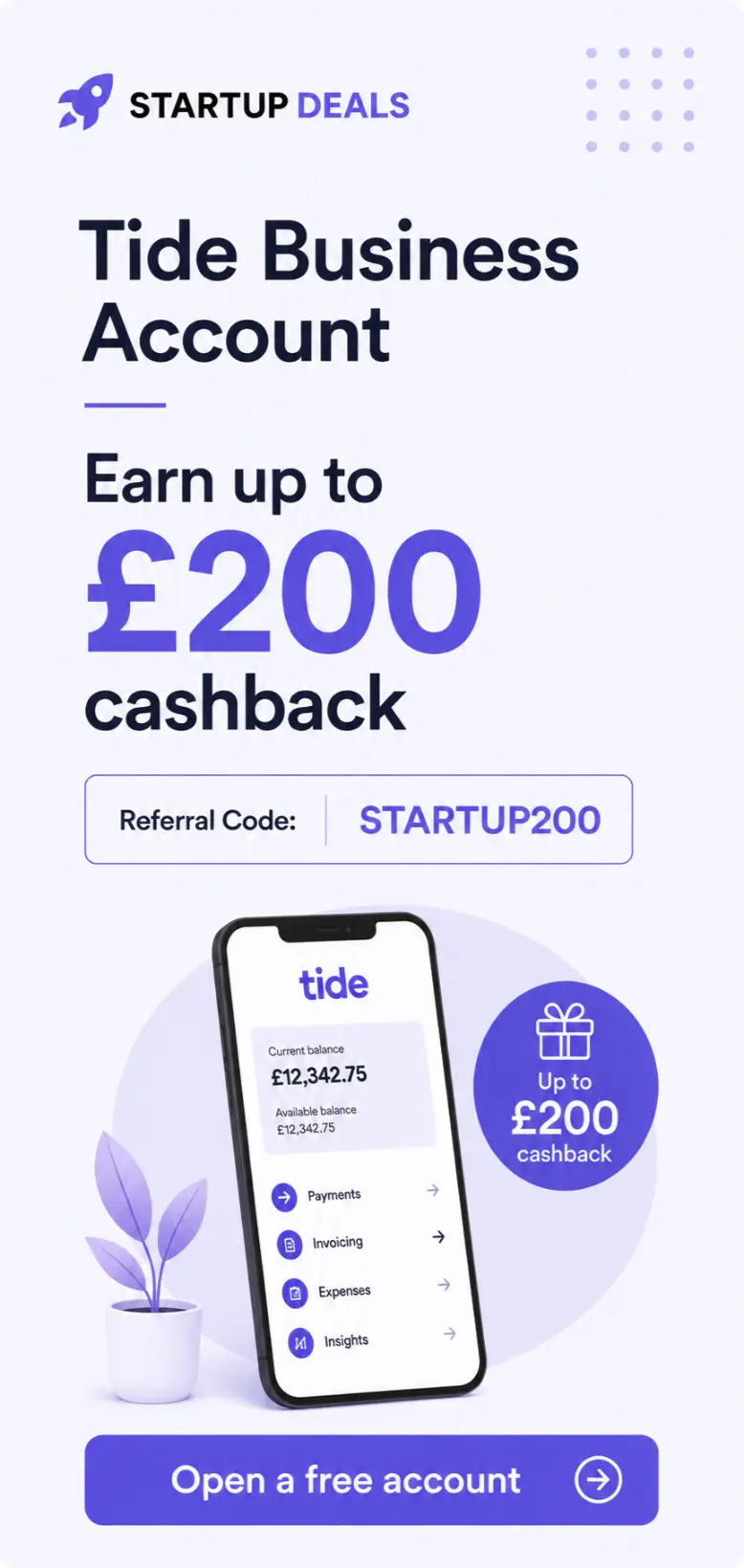
Earn Up to £200 Cashback with Tide
For businesses considering Tide vs high street banks, one of the most attractive reasons to choose Tide in 2026 is the opportunity to earn up to £200 cashback through the current promotional offer.
Eligible new customers can access this offer by using the promo code STARTUP200 when registering their business and opening a qualifying Tide account.
The promotion consists of two separate cashback opportunities worth a combined total of up to £200.
The first reward is £75 cashback. To qualify, eligible customers must open their Tide account using the code STARTUP200 and spend at least £100 using their Tide card within the first 30 days after opening the account.
The second reward is worth an additional £125 through the Tide Instant Saver promotion. To qualify, customers must deposit at least £5,000 into their Tide Instant Saver Account within seven days of opening the account and maintain that balance for at least one month.
Combined, these two offers provide a potential cashback value of up to £200 for eligible new customers.
For many entrepreneurs comparing high street banks vs Tide, promotional incentives can help offset initial business expenses and provide additional value during the early stages of using a new banking platform.
Example Qualification Scenario
A newly incorporated limited company opens a Tide account using STARTUP200.
Within the first 30 days, the company spends more than £100 using its Tide business debit card. This unlocks the £75 cashback reward.
The business then deposits £5,000 into the Tide Instant Saver Account within seven days of opening and keeps the balance in place for one month. This unlocks the additional £125 reward.
The total cashback received is £200.
Many businesses conducting a tide v high street banks comparison find that traditional banks rarely provide a combination of modern business tools and promotional rewards of this nature, although offers vary across providers.
If you’re considering opening an account, you can apply here: https://startupdeals.co.uk/recommends/tide-business-current-account
Offer summary:
- Use promo code STARTUP200
- Open an eligible Tide account
- Spend £100 on your Tide card within 30 days to receive £75 cashback
- Deposit £5,000 into Tide Instant Saver within 7 days
- Maintain the balance for one month to receive an additional £125
- Total potential reward: £200 cashback
As always, eligibility requirements apply and offer terms may change over time. subject to change—check current T&Cs.
General FAQs About Tide and High Street Banks
Is Tide better than high street banks for startups?
Many startups prefer Tide because of its fast account opening process, integrated business tools, and digital-first approach. Whether Is Tide better than high street banks depends on your need for branch access and lending facilities.
Is high street banks better than Tide for established businesses?
Some established businesses may prefer traditional banks because of relationship managers, lending products, and wider financial services. This is why Is high street banks better than Tide can vary depending on business requirements.
What is the biggest difference in a tide v high street banks comparison?
The biggest difference is that Tide focuses on digital banking and business management tools, while traditional banks typically offer branch networks, face-to-face support, and broader financial products.
Which option is cheaper: high street banks vs Tide?
The answer depends on your transaction volumes and banking needs. Some businesses find Tide more cost-effective, while others benefit from the services included with traditional business banking packages.
Do I need a branch if I use Tide?
Most Tide users manage their finances entirely online through the app and web dashboard. Businesses that regularly rely on in-person banking may prefer a traditional provider.
Is Tide suitable for limited companies?
Yes. Tide supports limited companies and offers features designed to help directors manage business finances efficiently.
Which is better for sole traders: Tide or a high street bank?
Many sole traders favour Tide because of its simplicity and digital tools. However, some still prefer high street banks for familiarity and branch access.
Can I switch from a high street bank to Tide?
Yes. Many businesses move from traditional banking providers after evaluating Tide vs high street banks and deciding that digital banking better suits their needs.
Are high street banks safer than Tide?
Both traditional banks and Tide operate within the UK financial regulatory framework. Businesses should always review current FCA registration and FSCS protection arrangements before opening an account.
Are business funds protected?
Protection arrangements depend on the specific account structure and provider arrangements. Businesses should always review current FCA and FSCS information before opening any account.
Should I choose Tide or a traditional bank?
The best choice depends on your priorities. Businesses focused on efficiency and digital banking may prefer Tide, while those requiring branches, lending, and face-to-face support may favour traditional banks.
FAQs About the Tide £200 Cashback Offer
How do I qualify for the Tide £200 cashback offer?
Use the code STARTUP200 when opening an eligible account and complete the qualifying activities described in the offer terms.
What is the first cashback reward?
The first reward is £75 cashback after spending at least £100 on your Tide card within the first 30 days.
What is the second cashback reward?
The second reward is worth £125 through the Tide Instant Saver promotion.
How much do I need to deposit into Tide Instant Saver?
You must deposit at least £5,000 into the Tide Instant Saver Account within seven days of opening your account.
How long must I keep the savings balance?
The qualifying balance must generally remain in place for one month to meet the promotion requirements.
Can existing customers claim the offer?
Promotions are typically aimed at eligible new customers. Always review the current terms before applying.
Does the STARTUP200 code need to be entered during application?
Yes. To avoid missing eligibility, enter STARTUP200 during the account application process.
Does spending £100 need to happen immediately?
No, but the qualifying spend must normally be completed within the first 30 days after opening the account.
Is Tide better than high street banks because of the cashback?
The cashback can provide additional value, but businesses should still compare features, fees, and long-term suitability.
Recap
Choosing between Tide vs high street banks ultimately comes down to how your business operates and what you expect from your banking provider.
Throughout this guide, we’ve explored the key differences between digital-first business banking and traditional banking models. Tide focuses on speed, convenience, automation, and business management tools, making it particularly attractive for startups, freelancers, contractors, sole traders, and SMEs that want to simplify financial administration.
Traditional banks continue to offer advantages that many businesses value, including branch access, relationship managers, established lending facilities, and broader financial products. For some organisations, these services remain an important part of their long-term banking strategy.
When comparing high street banks vs Tide, it is important to evaluate more than just account fees. Consider how quickly you can open an account, the quality of day-to-day banking tools, customer support preferences, growth plans, and any specialist financial requirements your business may have.
For many modern businesses, Tide’s combination of mobile banking, expense tracking, invoicing, accounting integrations, and automated administration tools delivers significant value. The ability to manage finances efficiently can save time and help business owners focus on growth rather than paperwork.
Eligible new customers may also benefit from the current cashback promotion. By using the code STARTUP200 and meeting the qualifying conditions, businesses can earn up to £200 cashback. Apply here: https://startupdeals.co.uk/recommends/tide-business-current-account
As always, eligibility requirements apply and offers may change over time.
Conclusion
The decision between Tide vs high street banks is not about finding a universally better option. Instead, it’s about identifying the banking solution that best aligns with your business goals, working style, and future plans.
Tide has become a popular choice because it delivers many of the features modern business owners value most. Fast account opening, intuitive mobile banking, integrated invoicing, expense management tools, accounting software connections, and simplified administration make it particularly appealing for startups, freelancers, sole traders, contractors, and growing SMEs.
At the same time, traditional high street banks continue to play an important role within the UK business banking landscape. Businesses that require branch access, relationship-based support, extensive lending facilities, or specialised financial products may find that a traditional provider remains the better fit.
For many entrepreneurs evaluating high street banks vs Tide, the decision often comes down to convenience versus traditional infrastructure. Businesses that operate primarily online and value efficiency frequently lean towards Tide, while organisations with more complex banking needs may appreciate the broader services available through established banks.
If you’re still asking Is Tide better than high street banks or Is high street banks better than Tide, the answer depends on your specific circumstances. There is no single solution that suits every business. However, for many modern SMEs, startups, freelancers, and contractors, Tide offers a compelling blend of simplicity, technology, and business-focused functionality.
If you’d like to take advantage of the current promotion, eligible businesses can earn up to £200 cashback by opening a Tide account with the code STARTUP200 and completing the qualifying requirements.
Get started here: https://startupdeals.co.uk/recommends/tide-business-current-account
Offer subject to eligibility criteria and may change without notice. Always review the latest terms and conditions before applying.
Latest Posts:
- Zempler Bank Review 2026: Is It Good Value for UK Startups?
 Introduction Zempler Bank offers a genuine UK business bank account from £0 per month, with app and online banking, Post Office cash deposits and built-in tools for invoicing, receipts and… Read more: Zempler Bank Review 2026: Is It Good Value for UK Startups?
 - Hoxton Mix vs Virtually There: Which Virtual Office Service Is Better?
 Introduction If you’re comparing Hoxton Mix vs Virtually There, you’re likely searching for a virtual office provider that offers the right balance of professionalism, affordability, and flexibility. Whether you’re launching… Read more: Hoxton Mix vs Virtually There: Which Virtual Office Service Is Better?
 - Hoxton Mix vs Icon Offices: Which Virtual Office Is Better?
 Introduction Choosing a virtual office provider can have a significant impact on how your business is perceived, how you manage your mail, and even how effectively you maintain privacy as… Read more: Hoxton Mix vs Icon Offices: Which Virtual Office Is Better?
 - 7 Powerful Benefits of Using a Hoxton Mix Virtual Office Address
 Introduction For startups, freelancers, sole traders and growing SMEs, establishing a professional business presence can be challenging. Renting physical office space in London is often expensive, particularly during the early… Read more: 7 Powerful Benefits of Using a Hoxton Mix Virtual Office Address
 - Hoxton Mix Review: Features, Pricing, Pros and Cons Explained
 Introduction If you’re searching for an honest and detailed hoxton mix review, you’re likely comparing virtual office providers and trying to decide whether Hoxton Mix offers good value for your… Read more: Hoxton Mix Review: Features, Pricing, Pros and Cons Explained
 - Hoxton Mix Virtual Office Discount: Save 10% on Your First 12 Months
 Introduction If you’re looking for a professional London business address without the cost of renting physical office space, a Hoxton Mix Virtual Office discount could help you reduce your startup… Read more: Hoxton Mix Virtual Office Discount: Save 10% on Your First 12 Months
 - Tide Referral Code 2026: Powerful Guide to Claim £200 Cashback with STARTUP200
 Introduction If you’re looking for a Tide referral code in 2026, you’re probably searching for the best possible deal before opening a business account. Whether you’re a sole trader, freelancer,… Read more: Tide Referral Code 2026: Powerful Guide to Claim £200 Cashback with STARTUP200
 - Tide vs High Street Banks: Powerful 2026 Review
 Introduction Choosing the right business banking solution is one of the most important decisions a UK business owner can make. Whether you’re a sole trader, freelancer, contractor, startup founder, or… Read more: Tide vs High Street Banks: Powerful 2026 Review
 - Tide Business Account for Tradespeople | Powerful Guide 2026
 Introduction Running a trade business involves much more than completing jobs and keeping customers happy. Whether you’re a plumber, electrician, builder, carpenter, roofer, landscaper, painter, heating engineer, or general contractor,… Read more: Tide Business Account for Tradespeople | Powerful Guide 2026